CHAPTER THE THIRTEENTH.
THE BOMBARDMENT OF BELGRADE—PREPARATIONS FOR THE BOMBARDMENT AND CONCERT WITH AUSTRIA—NARRATIVES OF A FOREIGN MERCHANT AND A SERVIAN GENTLEMAN, PRESENT IN BELGRADE DURING THE BOMBARDMENT.
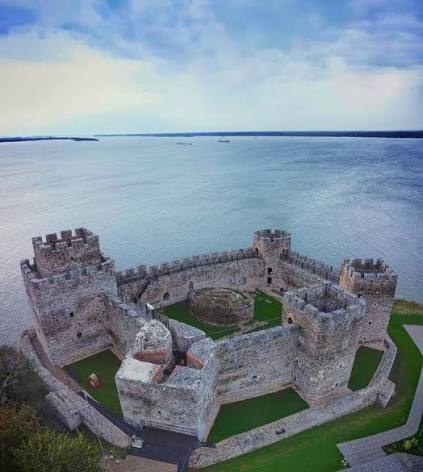
About a fortnight after I had left Belgrade, occurred an event which is almost without parallel in modern history. On Tuesday, June the 17th, without any warning which might have allowed of the removal of the women and infants, the Turkish soldiers in the citadel proceeded to bombard a city full of peaceful shopkeepers and destitute of the slightest means of defence or resistance. The situation of the citadel on a rising ground, necessarily places the whole city at its mercy; and along the streets and through the lanes crowded with a defenceless people, shot and shell rained for upwards of five hours, until, mainly through the firmness of the English and French consuls, this cruel and unprovoked bombardment was suspended, but not until the walls of the town were coloured with the blood of the innocent victims of Oriental barbarity. It may seem out of place to detain the reader with the details of an event which occurred after my journey had closed. But though the actual bombardment did not take place during my stay, all the preparations for it occurred during my residence in Belgrade ; I make no apology, therefore, for tracing the steps which led to this deplorable act, especially as I am permitted to append two narratives drawn up immediately after the bombardment,—the first by a foreign gentleman, alike unconnected with either the Servian Government or the Turkish authorities, and whose impartiality is, to all who know him, a guarantee of the fidelity of his narrative ; the second by a Servian gentleman who was also on the spot, and who had ample opportunities of knowing the truth of every -word which he has written.
Two days before I left Belgrade, it was known that Achir Pasha, the governor of the citadel, had made an official visit to the Austrian commander at Semlin. At the same time the son of the Pasha proceeded to Pancsova, the great military depét of Austria in the lower part of Hungary, and on the conclusion of his visit left on a tour of inspection to the Turkish garrison at Semandria. A strange announcement which crept into the continental newspapers awakened the curiosity of people as to the occasion of these visits, whilst the explanation offered by the same newspapers was 80 incredible, that it was generally rejected. It was stated that the visit of the Turkish Pasha to the Austrian commander, was made in order to obtain a promise of assistance in the event of the Servian troops making any attack upon the garrison of Belgrade. As there seemed: no likelihood of any such attack being made, and as, moreover, the entire army of Servia, scattered over the whole extent of that country, only equals the strength of this one Turkish garrison, such a danger appeared in the highest degree chimerical It is true that there is a large body of volunteers, who might at some future time be brought together in the event of an invasion of the country, but these are at present not even embodied, and are still without arms. Such an explanation, therefore, of the motive for the Pasha’s visit appeared absurd.
The very absurdity of a statement is, however, sometimes a testimony to its probable truth. No one could have conjectured such a reason. It was the unlikelihood not of imagination, but of truth.
A fortnight, however, passed away, and the visit and the explanation offered were alike almost forgotten by the people of Belgrade, when the following singular incident again awakened suspicion.
The Austrian Government obtained some years since the right of managing the offices of the general post throughout European Turkey. Thus whilst all letters from one part of Servia to another are delivered by Servian officials, those coming to Belgrade from any part beyond the frontier of Servia pass through the Austrian post-office. For the convenience of merchants and others having a regular and large correspondence, it is usual to open weekly accounts with the post-office, and on Saturday evening such accounts are settled. A friend of my own in Belgrade had long been in the habit of so doing. On Sunday, the 15th of June, a letter was sent from his house for transmission to England. On being presented at the post-office, payment was demanded. “It is from Mr. ——,” was the reply of the servant. “That may be,” was the rejoinder of the postmaster, “you must pay now.” “We have a weekly account,” said the astonished messenger; “and I paid it up last night.” “That is so,” was the answer, “but we have orders to require the postage with every letter.” A conversation and explanation ensued, and some delay, as the servant was not provided with the proper money, the Austrian authorities always declining to receive their own paper money, and requiring a particular kind of coin for all letters. “But what does all this mean?” asked the servant or an official to whom he had given his letters for years. “Something is going to happen,” was the answer, “and we are ordered to remove the post-office to-morrow to Semlin.” Something was going to happen. On the servant’s return, conjecture was busy as to what this something was which was known as about to happen to the Austrian Government, and which had led to orders being issued to insure the safety of the servants of their post-office.
The citizens of Belgrade had not long to wait for a solution of the enigma. On Monday, June the 16th, the Austrian post-office at Belgrade was broken up, the employés retired to Semlin, and early on Tuesday the Turkish fortress opened fire upon the city. Now be it remembered, that the arrangements for all this were made before any act had been committed by the Servians which the Turkish Government allege as .the provocation for the bombardment of Belgrade.
What followed will best be gathered from the narrative to which I have already referred :
“On Sunday, the 15th June, the Servian population of Belgrade was in the state of most perfect quietness, notwithstanding the repeated annoyances which they had for some days past received from the Turks. The road to Topschidere, a country house belonging to Prince Michel, situated about half an hour’s drive from the city, and the favourite Sunday resort of the people of Belgrade, was thronged with carriages and people on foot in holiday costume as usual. The Princess was alone at the Palace, the Prince being at that time on a tour to Schabatz and its neighbourhood, for the purpose of inspecting that part of the country which he had not been able to visit in the preceding year. Everything seemed to bespeak the most profound peace, and no one had the slightest expectation of the events which were about to happen.
About three oclock in the afternoon, a Servian boy, twelve years of age, and an older lad, went to draw water at a well situated near the Servian and the Turkish police-stations, both of which are in the same neighbourhood, and separated only by a narrow lane. Almost immediately after they had arrived, two Turkish soldiers came to the well, and attempted to push the Servians away, and to draw water before them. A quarrel took place, when the Turkish soldiers drew their swords, and without further ceremony put the Servian lads to death. Immediately several Servian gendarmes came out of the police-station without arms; and having arrested the two Turkish soldiers, were taking them off to the Turkish police-office for the purpose of handing them over to the military authorities. A discharge of musketry, fired from the Turkish police-station, killed the Servian gendarmes, and a general fight then began between the occupants of the two policestations. The citizens at once armed themselves, and proceeded without delay to take possession of the two gates leading to the Turkish quarter, known by the names Varochkapi and Savekapi. The Turkish soldiers who guarded these gates were, however, allowed to retire into the fortress without being attacked on the road, and indeed without any attempt on the part of the Servians to follow them. All this time, however, the police-station in which the murderers of the Servian boys had taken refuge, was surrounded by their friends and a large concourse of people. In the course of a few hours the Servian gendarmes and chasseurs joined the populace, and a brisk fire was kept up upon the Turkish police-station, which, it was discovered, was held not by the usual guard, but by about three hundred regular soldiers, together with a number of irregulars and militia, whose families had, in anticipation of these events, been already taken into the fortress. In a very short time the whole population of the town was in arms, some of whom surrounded the Turkish police-station, whilst others dispersed themselves throughout the whole of the Turkish quarter, the inhabitants of which had abandoned it, and had been withdrawn into the fortress. It was at this moment of excitement, when the people’s desire for vengeance had been lashed into fury, that some violence was committed by a few of the dregs of the Servian population, who pillaged the Turkish shops. The disorder in this quarter, and the firing in the neighbourhood of the Turkish police-station, were kept up all night, and until the next morning.
“It would be impossible to say too much in praise of the conduct of the English Consul-General, Mr. Longworth, who, on three different occasions, went through the thick of the fire to the fortress, in order to see the Pasha, with the object of prevailing on him to put an end to the battle, which had now become general.
It was not, however, until Monday morning, at his third visit, that Mr. Longworth was able to prevail on the Pasha to suspend hostilities, and then only on the condition that the three hundred Turkish soldiers, who had been surrounded in the police-station, should be delivered, safe and sound, at the fortress.
“It is evident that, in the state of exasperation into which the Servians had been driven, this was no easy task. To accomplish it, extraordinary prudence and a degree of firmness were needed, to keep in check an enraged populace, and avoid a renewal of the conflict. For this purpose the consuls of all the great powers united themselves with the authorities of the Servian Government, and the Turkish soldiers having been placed between two lines of Servian troops and policeofficers, were withdrawn from the Turkish guardhouse.
At the head of the column, Mr. Garaschanin, the President of the Council of Ministers, placed himself. The consuls, each with the colours of his nation, joined the cortége, and so set off fer the fortress. Notwithstanding the irritation of the Servian people, the most perfect order was maintained. So great was the respect of the people for their Prince and his Government, as well as for the representatives of the great powers, that not a single shot was fired by any of the populace. But, will it be believed? scarcely had the cortége reached the fortress on this mission of peace, when two shots, fired from the citadel, struck down two Servian soldiers. It is due to the presence of mind of those who were at the head of the Servian party, and especially to the calmness of Mr. Garaschanin, that no further mischief ensued, and that the suspension of hostilities was maintained, notwithstanding this outrage. Pretending to know nothing of the treacherous murder which had been committed, and continuing their march to the fortress, they surrendered the whole of the Turkish soldiery. An armistice was then concluded, and public tranquillity appeared about to be restored. This armistice was signed by the Servian Government, by the Pasha in command of the fortress, and by the consuls of all the great powers. In a very short time the city resumed its usual quietness, the shops were again opened, and the people went about the streets as before. Up to this time, with the exception of the Austrian employés, the foreign residents had not thought of leaving the place, nor had they adopted any measures of personal safety, so entirely did they trust to the protection afforded them by the presence of their respective consuls, and to the convention which had just been made. The next day, which was Tuesday, as early as six o’clock in the morning, the markets were held in the public squares as usual ; the shops were opened, and everything was quiet. About eight o’clock in the morning, the people assembled in the principal square, in order to pay the last honours to one of their officers, and to some soldiers who had been killed. At half-past eight two messengers, carrying a white flag, came from the fortress, and went to the Servian police-office, which is situated on one side of the square in which the daily market is held. They were immediately shown in to Mr. Garaschanin, who was sitting there with a view of preserving the public tranquillity, by every means in his power.
These two messengers were the bearers of a request from the Pasha to Mr. Garaschanin, that he would assemble the consuls at the fortress. He immediately sent to the French consul, who was his nearest neighbour, and that gentleman lost no time in assembling his colleagues, whose residences were in different parts of the city. The Prussian Consul was the first to respond to the summons of the French consul, and to arrive at the police-station, which he reached about nine o’clock. The other consuls were still on their way thither, and the funeral procession, preceded by a military band, was moving towards the cemetery.
It was at this very moment, when the consuls, with the Servian authorities, were on their way to the fortress, at the invitation of the Pasha, that a bombardment was commenced from the ramparts, of which history furnishes no example, and of which the violence is without any precedent. The people of the city immediately ran to their houses, and took up whatever arms they could find. The French and Prussian consuls immediately left for the purpose of exerting themselves for the safety of the people and property under their immediate care. In doing this, however, they did not escape without injury from the destructive fire which. burst from every embrasure of the fortress. The most heroic resistance was extemporised, and a kind of organization was effected without loss of time; and it can scarcely be a subject of wonder that the two messengers, who had been sent out with this treacherous flag of truce, lost their lives. The gendarmes and the chasseurs, although few in number, with the help of the people, repelled a sortie from the citadel, in the course of which a colonel and several other Turkish soldiers were killed. Availing themselves of the shelter of the houses opposite the citadel, the Servian gendarmes and chasseurs fought bravely; and so true was their firing, that thirty-six Turkish gunners were killed by the side of their guns. The bombardment was continued with activity for five hours; and if, happily, the amount of the damage done was smaller than might have been expected, that circumstance is to be attributed both to the ignorance of the Turkish gunners, and to the worthless ammunition with which they were supplied. The cathedral seemed an especial object of hatred; it was repeatedly struck, and three shots passed through the tower.1 Fortunately, three parts of the shells did not explode, and they were found lying about the streets and in the houses.
It would be scarcely possible to form any idea of the panic which took possession of the people of the town, surprised as they were in a moment of perfect quietness. During the first hours of the bombardment, the women and children hid themselves in the cellars of their houses; but when they were informed by the Servian authorities that, in the absence of regular troops, they feared the inability of the populace and the police to resist a second sortie from the fortress, women and children, both Servians and foreigners, and all those who were not able to assist in the defence of the town, in order to escape massacre from the Turks, determined to leave that part of the town which was near the fortress, even although, in order to escape, they had to pass through the showers of shells and shot which were ploughing up the streets. Barricades and redoubts were now hastily constructed, under the fire of the enemy, at the openings of the streets, and the utmost energy was shown in the preparation of the means of defence.
During. all this time the princess, who had not left her palace, was occupied in the protection of these poor people, reduced to want and misery, who had fled to her for protection.
As soon as tidings of what was taking place in Belgrade reached Prince Michel, he hastened back from Schabatz, and in concert with Mr, Garaschanin and the other ministers, took such steps as the circumstances of the case permitted and rendered necessary, The Senate was immediately convoked, and at once conferred on the Prince dictatorial powers ; whilst the whole people, whose entire confidence he possesses, rallied round him.
After several hours of bombardment, the representative of the Austrian consul went across to Semlin, from whence he proceeded to the fortress to ask for an armistice, during which he might remove such of the Austrian inhabitants who had not left the previous day. After five hours of bombardment, the pasha consented to an armistice of six hours. As soon as the other consuls heard what had taken place, they lost no time in going to the fortress, in the hope of obtaining an entire cessation of the fire. This was no easy task, as may well be imagined. The Servians had too much reason to distrust the Turks, and, on the other hand, the Turks could have little reason to hope for any good feelings from the Servians. In order to inspire both parties with confidence, the French consul-general gave himself up as a hostage to the Turks, thus becoming responsible for the Servians ; and the English consul-general, in order to become responsible for the Turks, gave himself up as a hostage to the Servians. The tent of the French consul-general was pitched on the glacis in front of the fortress, and that of the English consul on the Kalimaidan, a spot immediately in front of the Servian redoubts. The Prussian and Italian consuls, who with great energy seconded the efforts of their colleagues, undertook the duty of calming the irritation of the people. By these means tranquillity was restored as far as was possible under the circumstances.
These posts of the English and French consul were attended with no ordinary danger. The wanton murder of two or three children had exasperated the Servian population even more than the treacherous assassination of the soldiers; and in the absence of the Prince, it might fairly be questioned how far this could be counteracted. On the other hand, the fanaticism of the Mussulman soldiers had been inflamed, until the pasha in command had now extreme difficulty in restraining them from a renewal of the attack upon the city. At midnight, M. Tastu, the French consul, was aroused by hearing the Turkish call to arms, and by finding that the ramparts were filled with gunners, preparing to reopen fire upon Belgrade. Rushing to the gates of the citadel, he demanded to be led to the pasha, and learnt from him that the ombardment of the previous day was about to be renewed. The reason alleged for this was the movement of lights in the neighbourhood of the fortress, and the fear that the Servians were preparing to assault the citadel. M. Tastu demanded that the lights should be shown him; and, after some delay, he was led to the north face of the fortress, from which a few gleams of light were visible. The French consul pointed out that lights on the north of the fortress, and therefore on Austrian territory, afforded no pretext for the bombardment of a city lying wholly on the southern side of the citadel, and that the lights themselves were but the exhalation from the marsh between Semlin and Belgrade ; that, in fact, it was but the will-o’-the-wisp with its fantastic tricks. The consuls eloquence was in vain. The directions to the gunners were renewed, and the sleeping inhabitants of the city would, in a few moments, have been aroused by the death-storm of nearly one hundred pieces of cannon, which filled the embrasures on the southern line of the fortifications. M. Tastu pointed out, with much energy, that such an act must lead to the death of Mr. Longworth, the English consul, whose tent was pitched in front of the Servian barricade, nearest to the gate of the citadel. Even this consideration failed to move the Turkish commander; and it was only when M. Tastu threatened the pasha with the sure vengeance of the Emperor Napoleon, that the order was reluctantly withdrawn, and Belgrade was spared from a repetition of the horrors of the previous day, aggravated by the darkness of the night and the defenceless state of the citizens.
The Prince, for his part, by his wisdom and firmness, contributed powerfully to the establishment of order, while other measures, which circumstances seemed to require, were not neglected. With great promptitude, he immediately organized a force of nearly six thousand men, and incorporated them amongst the regular troops. Though this was a small army for such an emergency, yet these troops would have been found formidable to any enemy, since they were perfectly armed, admirably disciplined, and supported by forty pieces of cannon. The most severe measures were adopted for the purpose of preserving order in the city. Every ‘attempt at pillage was immediately punished by death, and one or two examples were sufficient to insure the most perfect tranquillity.
Twenty thousand peasants, organized into battalions, perfectly armed, marched, of their own accord, to Belgrade, to offer their services to the Prince. After a rest of two days, as their aid was not required, they were sent back to their fields. Every one obeyed without a murmur, and all maintained the strictest discipline. Some of the newspapers have most unjustly calumniated these brave fellows, whose conduct was so admirable, and whose devotion and submission to the Prince have never flagged for one moment.2
A few days after the cessation of hostilities, a commissioner, sent by the Porte, has been allowed freely to make his inquiries, and his report will show that, if the Servians are brave, and perfectly united with their Prince for the defence of their cause, they are at the same time prepared to wait with patience for the decisions of the representatives of the great Powers who are to meet at Constantinople, with regard to the satisfaction which they have a right to expect after such an outrage against all the rights of humanity, and such a contempt for the duties of civilization. But more than this: it is surely to be expected that the great Powers, under the collective guarantee of which Servia is placed by the Treaty of Paris of 1856, will find some means of effectually sheltering the people of that country from a repetition of similar barbarities.”
To this account of the bombardment, written by a foreign resident, I append a narrative of the same occurrences, sent me by a Servian gentleman. They differ only so much as histories written by independent witnesses always will.
“In the afternoon of Sunday, the 15th June, while the population of the city of Belgrade were enjoying their promenade into the country, intelligence was brought to the prefecture, that two Servians had been killed by the nizams (regular Turkish troops) at Tchoukour Tchesnic. The drogman (policeman) Nechitch came with some gendarmes to the spot, and found the servant of a Servian merchant, Alexander Nicolitch, nearly expiring. They were able to ascertain from him that he had been stabbed by three nizams, who were still near the place. Several women gave information to the same effect, having seen the murder from their windows. The drogman took the nizams into custody. As soon as he came in sight of the Turkish police-station, situated in the great square at Belgrade, close to the Servian police-station, about fifteen armed nizams, led by an officer, came out of their station for the purpose of rescuing their fellows who had been arrested. The drogman said to them, ‘One of our people has been killed,. and we are going to inquire into the matter.’ The Turkish officer, who carried his naked sword in his hand, lowered it, and at that signal the nizams fired. The drogman and two gendarmes, Pierre Bonovitch and Milan, fell dead, and another was severely wounded.
After having committed these murders, the nizams retired in haste into the police-station, from whence, in company with their comrades, they began to fire on the passers-by. Four Servian men and one woman fell under their fire.
The sound of the trumpets from the Servian prefecture warned the people that the public safety was threatened. The people ran to arms and occupied the approaches to the principal square. In a short time a detachment of nizams, under the command of a captain, was seen coming out of the fortress on its way to reinforce the Turkish guard. The people stopped the road, and in spite of the resistance of the soldiery, who crossed their bayonets, notwithstanding the interposition of the officers of police, and that of M. Garaschanin himself, the people, whose numbers increased every. moment, refused to allow the detachment to pass.
The Turkish captain became alarmed, and determined to retrace his steps with his company, under the escort of Servian gendarmes. As soon as he approached the fortress he ordered his men to turn about, and at the word ‘fire’ the officer and two gendarmes of the escort fell dead. The soldiers then fired a second time upon the people, who were following at a distance. A general conflict now began at this place, while another, occasioned by the continued fire of the Turkish nizams, took place in the great square. The engagement became general. The nizams stationed at the police station and at the gates of the town gave frequent signals, by means of the trumpet, to the fortress, which replied to them in the same manner. The Turks were at length forced to give way at the Varoch and Save gates ; but the Widin and Stamboul gates, both large and solid buildings, as well as several mosques, still held out.
During the night of the 15th, no pains were spared by Mr. Longworth, the English consul, who on four occasions risked his life in going to the fortress, and from thence to M. Garaschanin, for the purpose of putting a stop to the effusion of blood. M. Garaschanin declared that it was beyond his power to restrain the violence of an exasperated population 80 long as the Pasha and the Turkish troops continued to occupy the town; and after much hesitation on the part of the Pasha, the following convention, signed at first by all the consuls, was agreed to by M. Garaschanin, the Minister for Foreign Affairs, and Achir Pasha.
“ Between M. Garaschanin and his Excellency the Pasha, Governor of Belgrade, and in the presence of the members of the consular body now in that town, M. Garaschanin having declared that he could not answer for the tranquillity of the town without the measure hereafter mentioned: It has been agreed ‘that the question of the gates is reserved by both sides to be disposed of elsewhere, and that with this reserve the Turkish soldiers who still occupy them shall be withdrawn, as well as the Turkish police, in order to establish the public security, which has been so unhappily disturbed. This measure is taken under the following conditions :-
1. M. Garaschanin makes himself responsible for the safety of the troops until their return into the fortress.
2. The houses and property of the Turks residing in the town shall be guaranteed and respected, and those of the inhabitants who shall remain in their houses shall have every protection.
3. Turkish families, while they withdraw, shall neither be molested nor insulted.
4. M. Garaschanin engages to give the necessary orders, by means of the telegraph, to prevent any violence against the other fortresses of the country, as well as against their Mussulman inhabitants.
Signed in duplicate, in the fortress of Belgrade, the 4th—16th of June, 1862.
(Signed) ACHIR, ETHEM, GARASCHANIN,
LONGWORTH, TASTU, VLANGALY,
MERONI, VASSITCH.’”
“Notwithstanding this convention, which was signed in the morning, about eight o’clock (according to which the Turks ought immediately to have laid down their arms or to have withdrawn to the fortress), the Turks who inhabited the part of the town on the bank of the Danube would not cease their hostilities till four o’clock in the afternoon, and it was only at that hour that the Servian authorities were able to get possession of that part of the town, occupied by a mixed population, and establish order. It is therefore only from this time (four o’clock in the afternoon of the 16th June) that the Servian authorities can be held responsible for their fulfilment of the stipulations of the convention, and for the maintenance of order.
“But the Servian Government has the testimony of all the consuls, and of all those who were then at Belgrade, that after the Turks, who inhabited the bank of the Danube, had withdrawn from the town, and the Servian authorities were in possession, the most exemplary order began to reign in the town, which was maintained through the night, and until the bombardment began. It has been said that as soon as the Turkish residents left their houses, they were plundered by a disorderly mob, and that for this pillage and disorder no redress was offered by the Servian authorities. To this charge it would have been sufficient to reply that there was no pillage and disorder for which the Servian authorities were responsible ; but there is more than this to be said,- although no one could have held the Government responsible for what passed during the contest prolonged by the Turks notwithstanding the convention. M. Garaschanin, having learnt that during this period some Turkish houses had been attacked and pillaged, gave immediate orders to have all the goods which had been taken, brought to the prefecture, and this order was executed with the greatest strictness. M. Garaschanin informed the Pasha, that having learnt that during the contest so unfortunately prolonged by the Turks till four o’clock, notwithstanding the conventions and the summonses which had been addressed to them to surrender, some houses had been pillaged, he had given the most stringent orders to have all the goods restored which had been taken, and that he hoped everything would be given up; but that in any case he declared himself ready, in the name of his Government, to make good the value of every object which should not be restored. At the same time M. Garaschanin requested the Pasha to make this offer known to all the Turks who had houses in the quarter referred to, in order that they might know that they had no loss to suffer.
The opponents of Servia have alleged that the next morning muskets were fired at the garrison in the citadel. This is so far from being the truth that not only was no shot fired at the garrison in the citadel, but it is notorious that early in the morning the garrison in the citadel began to fire shots on the town which were not returned. But at six o’clock in the morning, M. Garaschanin sent his drogman to the Pasha to request him to put a stop to these proceedings, which compromised the peace so happily established. And subsequently, when M. Garaschanin complained of this to one of the consuls, one of them, whose residence is not far from the fortress, stated that he had seen several balls which had been fired from the fortress fall in front of his house.
The Turks have said that this alleged firing of muskets at the garrison in the citadel was the immediate cause of the bombardment. The truth, however, is that this supposed occurrence never in fact took place, as has just been shown. Not only is that so, but the bombardment was altogether so unprovoked and so unexpected, that at first it was believed by the consular body to have been commenced by the nizams in defiance of the Pasha, against whom they were supposed to have revolted. But at one o’clock, on the 17th, while the bombardment was going on, M. Vassitch, the Austrian consular agent, came from the fortress to the residence of the English consul-general, where the rest of the consuls were assembled. To their great astonishment the Austrian consular agent then informed the consuls that the garrison had not revolted against the Pasha, as had been supposed up to that time; but that the bombardment had taken place under his (the Pasha’s) express orders. M. Vassitch having added, that the Pasha desired to have an interview with M. Garaschanin and the consular body. Mr. Longworth, the English consul, in a moment of generous indignation, was the first to exclaim, ‘that he would have nothing to do with barbarians who, without any just cause, without ahy previous notice, and in contempt of a solemn convention agreed the day before, fired shells and shot on a peaceable commercial town filled with women, children, aged people, and invalids; that the responsibility of such an act must fall altogether on the fanatical heads of those who counselled and ordered it, and that he (Mr. Longworth) would have no interview with the Pasha, nor quit the burning town; but that he would remain with his countrymen to share the sad lot of the inhabitants of Belgrade.’
The utterly indefensible character of the bombardment is put in a clear light by the protest signed by the consuls as soon as they were made acquainted with the fact that the bombardment had been ordered by the Pasha. The protest is as follows :—
‘The Pasha, Governor of Belgrade, having given orders for the bombardment of the town without any previous notice, and having, it is true, convoked the consular body, but without having even heard them, and when every one had the right to rely upon the convention passed with the Servian Government in the presence of all the members of the consular body, the undersigned leave upon him the responsibility of an act so contrary to the principles of the rights of nations, and after having protested in the most formal manner, they can henceforth do no more than wait in the bombarded town the fate which may befal their countrymen, until the orders of their Government shall reach them.
(Signed) LONGWORTH, TASTU,
VLANGALY, MERONI.
Belgrade, 17th June, 1862.’
With regard to the statement that the town was bombarded at intervals for four hours, the truth is that during the whole of the 16th, after the signing of the convention, the nizams never ceased to fire from the ramparts on the houses situated on the plateau in front of the fortress, and this under the eyes of the Pasha. On the morning of the 17th, very early, the firing was resumed, and at half-past eight on that day it became a regular bombardment, which was continued without intermission till about two o’clock in the afternoon, when it ceased ; but the nizams continued a fire of musketry until nightfall. The Turks, moreover, allege that these lamentable events had their origin in the violation by the Servians of the relations established by treaties between the Sublime Porte and Servia. A sweeping accusation of this nature is easily made ; but no one instance of a violation of a treaty by the Servians is pointed out, and for that best of reasons that none exists. If the treaties have been violated, it has been by the Porte.
Thirty years ago the Sublime Porte bound itself by treaties and by hatticherifs to withdraw the Turkish inhabitants from Servia, and for thirty years these engagements have continued unfulfilled. Had this not been the case, the present disturbances would not have taken place, for they owe their origin to the forced retention in the same town of people of hostile races and incompatible habits. It is the Porte which has, in direct violation of all treaties and engagements, meddled with the internal affairs of Servia, even to the extent of putting in peril her autonomy, and that in defiance of the treaties which guarantee to Servia her internal independence. It is the Porte that has turned a deaf ear to all the remonstrances which the Servian Government has not ceased to address to her in the hope of obtaining justice for Servia.”
Since these narratives were written, the Government of the Sultan has published its own account of the bombardment, and the circumstances which led to this act of atrocity. The defence offered is based on two facts:-
(I.) That the Government of Servia had enrolled a large and, as the Turkish Government considered, a needless number of volunteers.
(II.) Certain acts of violence committed by the Servian people upon the Turkish shopkeepers of Belgrade.
The whole of Roumelia and Bosnia were in a state of internal agitation, which threatened before long to grow into insurrection. The inhabitants of the Hertzegovina were actually in a state of warfare, and their country was occupied by a Turkish army. The independent principality of Montenegro was surrounded by another army of Turks under Omar Pasha. Surely, whilst the whole frontier of Servia was in this state, it was the duty of the Prince of that country to guard against the very probable contingency of the war spreading into his own territory. The Porte may dread a volunteer force, but the Government of England has no doubt endeavoured to remove all such groundless fears by informing the Sultan that a force of volunteers can never be the instrument of aggressive warfare, and that it is only calculated for defence, and therefore that the existence of volunteers, however numerous, is a guarantee for peace, not an incentive to war. The British Government has, or at least will, no doubt, lose no time in showing the great value of a volunteer force, such as exists in this country, and will insist on the right of any people arming for the preservation of their independence. But whether the Sultan may or may not participate in these sentiments, the existence of the Servian volunteers was clearly a matter for diplomacy, not for so extreme a measure as the sudden bombardment of a quiet and defenceless city, especially as none of these volunteers were armed.
But the second complaint made by the Government of Turkey against the Servian people, namely, acts of violence alleged to have been committed against Turkish residents in Belgrade, is one which demands a preliminary observation, as to the right of Turks to reside in the city, or in any other part of Servia, except within the walls of the fortified places.
The result of the Servian War of Independence was to drive the Turks not only from the open field, but also from every fortress in the country. It is to be regretted that the great Powers, which stood passive during the time of war, should, when it was over, have interfered and guaranteed the independence of Servia at the cost of permitting the Turks to return and take possession of the fortified places.3 But it is surely right that those Powers which have done so should insist that the treaty dictated by themselves should be scrupulously carried out, Now, the Treaty of Akerman, made October 7th, 1826, between Russia and Turkey, and which was confirmed, so far as it regards Servia, by that of Paris, March 30th, 1856, provides that no Mahometan subject of Turkey should be allowed to reside in Servia, except those belonging to the garrisons ; that all Turkish civilians should withdraw from Servia within eighteen months after the signing of the first-named treaty; and that such subjects of Turkey who were possessed of landed property, and unable to dispose of it, should receive the rents of such property from the Servian Government. It is therefore a breach of the Treaties of Akerman and of Paris for any Turk, excep» the members of the respective | garrisons, to live in Servia. Now, how have these treaties and the hatticherif issued by the Porte immediately after that signed at Akerman, been carried out? They were at first evaded, and then deliberately broken. Under the pretext of a difficulty in disposing of their landed property, the Turkish shopkeepers continued to reside in all those towns which possessed a Turkish garrison, though the Treaty of Akerman seemed to have expressly guarded against this breach of faith, by stipulating that on their removal, the Servian Government should collect the rents and forward them to their respective owners. When this pretext failed, the Turkish Government proceeded to set aside the provisions of the treaties in a singular manner. It awarded to every man able to bear arms a yearly stipend of a few pence, and called him a supernumerary to the garrison nearest to which he was living. And now, by the recent State paper in which the Porte endeavours to justify the bombardment of Belgrade, a further right is claimed on behalf of the Turks, and the whole space within the rayon of each fortress is declared to be Turkish and under Turkish rule.
such a cost as that of Paris; and the precedent which is set of disregarding the covenant of so solemn an instrument, may be one which other Powers may hereafter copy, and plead the example of Turkey in justification of their disregard of the obligations of this treaty. If Turkey were called upon to carry out faithfully the Treaty of Paris, which expressly confirms the “anterior regulations” of Akerman, no such collisions could take place as that which is now pleaded as an excuse for this frightful act of barbarity; but so long as the breach of general treaties is permitted, and the Turks maintain their present position in the midst of the towns of Servia, then any agitation in Bosnia, and any insurrection in Roumelia, will lead to an outbreak of fanaticism:on one side or another, and the peace of Europe and of the world be again endangered.
- The roof of the archbishop’s palace and that of the Theological College adjoining were totally destroyed. ↩︎
- It was reported in several newspapers that these peasants had broken into the houses and plundered the property of the foreign residents in Belgrade. As the narrator is one of these foreign residents, his testimony on this point is valuable. ↩︎
- The Turks at present occupy seven fortresses in Servia: Fetislam, Ada Kale, Semandria, Belgrade, Schabatz on the Danube, and Sokol and Ushitza in the interior of the country. Of these places, Fetislam and Ada Kale are under the jurisdiction of the Pasha of Widdin; the remaining five are included in the pashilate of Belgrade. Again: Semandria and Belgrade are garrisoned by regular troops; the remaining five only by the shopkeepers of the Turkish quarter in each town. ↩︎