by Herbert Vivian
CHAPTER I
THE COURT
King Alexander – His firmness – Industry – Short sight – Self – possession- The Prince of Montenegro’s visit – King Alexander’s habits – Appearance – Affability – Coup d’état – Parents – Tact — Love of order – Mannerisms – Etiquette – Quiet strength – King Milan – His constant interference — Queen Nathalie – Her influence – A fawning mercenary – The Queen’s charms – Her saintly patience – High abilities – Divorce – The unsettled succession – Prospects of King Alexander’s marriage – His ambition and future .
KING ALEXANDER certainly affords one of the most interesting figures in the whole Balkan peninsula . Still in his teens , he it is who bears practically the whole burthen of government , imposing his youthful will upon grey – bearded statesmen old enough to be his grand- fathers . Il est très tenace , ‘ said M. Novaković , the late Premier , to a friend of mine ; and everyone who has come into personal relations with his Majesty is agreed that , once he has made up his mind , there is no gainsaying him . But he does not by any means jump hastily to conclusions . Mistrusting his own lack of experience , he studies every question , as it arises , most thoroughly and from every point of view . ‘ Are you very busy just now ? ‘ he asked one of his Ministers the other day . Well , ‘ he continued , on receiving an affirmative reply, ‘I can sympathise with you, for I have been reading very hard in view of the proposed revision of the Constitution. I have not worked less than six hours a day during the last two months.’ The Minister
told me that he knew precisely what books the King had been studying, and that they were very well selected. He added that the King is very quick to grasp a point, and has an excellent memory. It is a mistake, however, to suggest, as some have done, that he was more suited to be a professor than a king.
The only pretext for this suggestion is the impression produced by his pince-nez. This he has a half-nervous : habit of taking off and replacing frequently. He wears f it without a cord, and as he was readjusting it at the ; review during the Prince of Montenegro’s march-past last year his horse threw up its head and the pince-nez fell to the ground. He was quite lost without it, for he cannot see two yards in front of him, but, as usual on ceremonial occasions, he kept his self-possession completely, though it was some little while before he could attract anybody’s attention to pick the glasses up. His short sight is not inherited from either of his parents, but appears to have been brought on by straining his eyesight through too much study in insufficient light soon after he came to the throne. This sounds like chaff about a young king on whom so much care was lavished, but is, I am assured, the case. One effect of his short sight is to incline him to stoop in private life. His natural impulse is to bend forward to see anything , which presents itself.
But in public he always holds himself very well, and : has quite a martial appearance. When he received the Prince of Montenegro at the railway station, he had far more control over his features than his wily old guest, and contrived to convey a far imore convincing impression of friendliness, though he scarcely moved a muscle. ‘Il sait bien son metier, ce jeune homme-la,’ as a French journalist remarked to me more than once.
The visit of a Prince of Montenegro to Belgrade for the first time since the battle of Kosovo, more than 600 years ago, was naturally an interesting event, and deserves a short description. A vulgar critic might object that gala days are more magnificent at Budapest, but for my part I prefer the unaffected demonstrations , of these simpler souls. The old-world, dreamland dresses of Servian peasants are infinitely more natural and pleasing than the circus pageantry of Magyar magnates, and the commercial enthusiasm of millennial exploiters rings false beside the patriotic fervour of Slav blood-brotherhood.
Early in the morning I made my way to the railway station through the cheerful boulevards of Belgrade, decked out with red-blue-white bunting and Venetian masts bearing alternately the Servian and Montenegrin arms. On each side was a hedge of enthusiastic peasantry, gay with embroidered raiment ; officers, with scarlet uniforms and layers of sparkling decorations, urged their sleek thoroughbreds to express trot ; a corps f of cadets, goodly youths in smart green uniforms, swung their arms in martial zeal ; everywhere was bustle and zealous anticipation. I was one of the very few civilians , allowed the privilege of going on to the platform. There my first sight was that of the King’s guards, standing on the railway track in their serviceable uniforms of dark blue, polishing up their boots. At a quarter to nine they were drawn up along the platform to attention, | and I had an opportunity of walking down the line and recognising their fine soldierly bearing. They are picked men, and can stand comparison with almost any troops I know. The band struck up the Servian National Anthem, and I became aware of the presence of the King, in scarlet uniform and Russian peaked cap, standing upon a strip of carpet and looking every inch a monarch.
A bell rang, and the train steamed in. A portly, dusky gentleman, clad in a white linen frock-coat, thick waistband, and black tambourine cap, emerged all wreathed in smiles. Saving the dress, you had said a typical English squire. The young King stood to attention, advanced a step, and held out his hand with a few words of formal welcome. The Prince wrung his hand with great cordiality, kissed him on both cheeks, then gave him one additional kiss and a pat on the back to emphasize satisfaction, and the pair walked down the platform to inspect the guards, and back again. By this time the Prince’s suite had also emerged—six men dressed very much like their master, and a Mussulman Beg wearing a fez. The King presented his suite to the Prince, who clanked his heels together like a German, held out his hand (to be shaken, not kissed), and said a few words to each, maintaining ‘a broad perennial smile displaying his teeth. Then the Prince turned and presented his suite to the King, who again impressed me by his complete self-possession. He had plenty to say to each man, and evidently said it well. There was not a shade of embarrassment or even hesitation, and I judged from his manner that he ‘was quick, resolute, and at the same time most affable—one who would say smooth things and yet stand no nonsense.
The two Sovereigns drove off amid enthusiastic cries of “Zhiveli !” 1 from the crowd, and the King touched his képi repeatedly with most royal dignity. Presently the Prince passed his hand aflectionately through the King’s arm, and the latter was forced to go on saluting with his left hand. The display of affection was loudly applauded by the crowd. The appointments of the state coach were bizarre but picturesque, and I could not help admiring the grey liveries and flufly cocked hats of the postillions, for the colours were so happily blended.
The King is short and slight, but not thin, and he excels as much as an athlete as he does as a student. He went in for all the usual public-school examinations and passed them with great credit. He will work for six or seven hours a day during several months, and then give himself up almost entirely to swimming and hunting (his favourite pursuits) for several months more, transacting only the formal business which may be laid before him. But this is not a reproach to him, for more reasonably than many Parliaments—he works when there is work to be done, and takes his relaxation when no work presses. After his state-stroke he issued a delicious little manifesto announcing that now he would be able to resume his interrupted studies.
Since he has shaved his whiskers and inchoate beard, he looks a very proper youth. His features are regular, his mouth is firm, and his expression is singularly sweet. When he is looking his best, I can often detect a likeness to his beautiful mother. I am sure many hearts must beat fast as he goes the round of the saloons in the New Palace and chats unaffectedly with all the prettiest girls in turn. His manner then, and indeed on all other occasions, struck me as being just the right thing. He was all smiles and airy talk, without sacrificing his dignity or arousing comment by lingering too long with any special favourite. As most of the Servian girls are remarkably pretty, it must require a great deal of self-command to tear himself away at the right moment.
Whenever I have seen him, he seemed always on the alert, taking in every detail that occurred anywhere near him, and evidently most anxious to please everybody. I imagine him to be of a nervous, excitable character, easily elated and easily depressed. I am sure he cannot have enjoyed much appetite during the famous dinner which preceded his state-stroke; but I am equally sure that he never betrayed, by the slightest twitch or gesture, that anything unusual was afoot, for he has admirable command over his feelings and features.
As-for the state-stroke, no one seems to know precisely who inspired it. One of the Ministers told me ; he thought it was King Milan’s doing. But another eminent politician pointed out to me that it was directed against Milan’s partisans, and that Queen Nathalie was more likely to have prompted it. In any case, the
execution of the scheme was perforce left to the boy-king himself, and everyone is agreed that he carried it through with wonderful nerve and dramatic finish.
The differences between his parents placed him from an early age in a very awkward position, and, though he always did his utmost to bring them together, he was eventually obliged to takesides. At one time—and that during his minority, when his acts were unquestionably his Ministers’—he was compelled to seem to take his
father’s part ; but from all I hear, his sympathies were all through with his mother. He bitterly resented being dragged away from her side at the behest of the German Emperor ; and when the Queen was forcibly expelled from Belgrade, he would have rebelled against his Regents if he had not been powerless to interfere.
Certain it is that the mother and son are now the best of friends. They are continnally watching one another, for all the world like a pair of young lovers, and she reserves her sweetest smiles for her beloved boy.
On an emergency, as we have seen, King Alexander can play an heroic part, but his natural instinct is to emooth away every difficulty by fair words. He is a model of tact and the pink of courtesy. He is very observant, and always knows precisely who is and who is not present at a function. When he was making a tour through Servia, for instance, he would often ask why such and such a person had not been asked to meet him at dinner, and, if there were no valid excuse, would have the missing one sent for at once. Wherever he had travelled in the interior, I found that he had left golden opinions behind him. He knows just the right thing to say to everybody, and steers clear of all contentious topics. He knows how to set everyone at his ease, and is not only an agreeable talker, but, rarer still, an attentive listener. He has a keen sense of humour, and often turns aside a dangerous subject by some witty remark on the spur of the moment.
He has a great love of order and detail. In his study every little thing is precisely in its place. When he takes up a subject he is not content with mastering the broad outlines, but insists on going into all sorts of side issues and trivial particulars. He is very precise about his dress, and would be miserable if there were a wrinkle in his tunic or a speck of dust on his képi. But at the same time he cannot suffer from vanity, or else he would not tolerate for an instant the dreadful caricatures which appear upon his postage – stamps.
Unlike the Prince of Bulgaria , who rejoices to vary the tedium of his life at Sofia by receiving any foreign personage who may chance to be passing through , King Alexander is very chary of seeing visitors . He is not , however , wholly inaccessible to those who are fortified with proper credentials and supported by their Legation . When you are first ushered into his study , and find a young man in tweeds , with hands which are inclined to fidget and a speech which is far from fluent , you are disposed to credit current rumours of his nervousness . But you are soon undeceived , and it dawns upon you that what you have set down to nervousness is in reality the result of precision . He is so anxious to use exactly the right word , and , moreover , the prudent word , that he is by no means quick to find it , and he likes to observe favourite attitudes with minute invariability . You will have remarked that , whenever he crosses himself in the Cathedral , the arrangement of his fingers never varies , and they touch the same points upon his uniform with mathematical precision .
His Majesty’s costume at an audience reminds you of the difference between the sans-gêne of his Court and the punctilious etiquette at Sofia . The servants wear plain liveries and most of the courtiers plain frock- coats ; you encounter none of the bright scarlet pages , magnificoes in uniform , and marshals with long white wands who swarm in the Bulgarian Court . The King may even be seen on most afternoons driving to Top- chider or about his capital in tweeds and a ‘ bowler ‘ hat , which would horrify Prince Ferdinand . Though simple in his tastes , he is , however , by no means un- mindful of the dignity or of the responsibility of his position . If he does not talk easily with you , it is not because he feels any constraint , but because ex- perience has taught him to be always on his guard against possible misunderstanding . And at the same time it is impossible to call his charm of manner in question , for you are under its spell even when he is most upon his guard .
You come away with an impression of quiet strength , which is the greatest of all strength . It is said that the reason of his success so far , and the confidence in its continuance , lie in the fact that he is the unemotional ruler of an emotional people . Come what may , he will certainly never lose his head in any emergency .
The perfection of his French he owes , with many other good gifts , to his mother , who followed the habit of her native Russia in speaking French in the family circle . This , it will be remembered , was one of the pretexts whereby M. Ristić sought to keep mother and son apart : a lady who preferred the French language could not be a fit companion for a Servian King !
The powers behind the Throne are Queen Nathalie and King Milan . The latter , though he has abandoned the Throne , still seeks to wield the sceptre . In the palace , in the army , in the remotest country town he cherishes his partisans ; and such are his infinite craft and subtlety that he must always be reckoned with as a power in the State . He has a great charm of manner , and those who have come under his thrall are ready to pardon him anything . He takes immense pains to keep up the spirit of fidelity to his interests which still survives in many parts and classes of Servia . If he hears of any of his friends losing their position , he agitates to have them reinstated ; and if any of his enemies are promoted , he protests . Nearly all the King’s entourage are Milan’s adherents, who have never been removed, owing mainly to their patron’s influence. Of course, it is only natural that so adroit and experienced a politician should exercise a certain influence over his son ; and from time to time, particularly after a meeting between the King and his father, this influence makes itself felt. The dismissal of M. NovakovIć’s Cabinet the other month was, for instance, ascribable to Milan’s interference.
As an example of the latter’s methods, I may mention the case of my friend Captain Kurtović, who spends the greater part of his time in improving the breed of horses and organising race-meetings all over the country. These meetings are quite modest affairs, consisting merely of a local horse-show and a few small prizes for peasants’ races; but every time one of these meetings is held, King Milan sends a telegram to Captain Kurtović, congratulating him on his enterprise and hoping he will have good sport. Yet he has no reason to love Captain Kurtović, who was formerly his aide-de-camp and threw up his post, with many strong expressions, as a protest against the persecution of Queen Nathalie. And Captain Kurtović’s father, a charming old gentleman of the old school, displayed his feelings on the same subject with no less emphasis. When the ill-mannered boors then in authority at Belgrade refused the Queen the use of the royal carriages, this chivalrous old gentleman telegraphed at once to Vienna, and procured within fortyeight hours the most magnificent equipage that money could buy, for the service of his beloved Sovereign. Milan’s strongholds are certain regiments of the army and those eastern provinces of Servia which were acquired during his reign. At Nish, for instance, his birthday is celebrated as a general holiday, and the Te Deum in the cathedral is attended by the local authorities and officers in full dress.
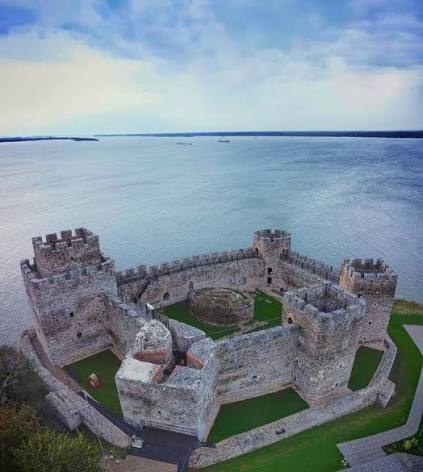
The Queen’s influence is now, however, distinctly in the ascendant. As evidence of this I may mention a little incident. I found myself one day at luncheon seated next to a certain Captain Kafka, a mercenary of Bohemian and, I imagine, Hebraic origin, who was employed to carry out M. Ristić’s infamous order for the Queen’s expulsion from Belgrade. He is now quartered at Smederovo,2 where the King and Queen usually spend the summer. During lunch he related how he had recently met the Queen just outside the church there, and she had extended her hand, whereupon he had kissed it and said, “Merci, Majesté, d’avoir pardonné” ‘Pardonné!‘ I exclaimed ; ‘what had she to forgive?’ ‘Didn’t you know,’ my other neighbour put in, it was Kafka who was sent to the Queen’s house with orders to remove her by force?’ ‘No,’ I replied, ‘I certainly did not know, or I should not be sitting here. Do you mean to say,’ I went on, turning to the culprit, ‘that you really did this thing?’ ‘Yes;’ he replied, colouring up to the roots of his hair, ‘I had to obey orders. What else could Ido?’ ‘Do!’I said; ‘a man of honour would have resigned his post or even his life first.’ ‘Ah!’ he returned with a cynical laugh, ‘if I had only known how matters would eventually turn out, I should certainly have resigned, and now—I should be at least a major.’
The wisdom and goodness are only equalled by the beauty of this transcendent Queen. It is a beauty which 10 pencil has been able to reproduce, and which no pen could ever justly describe. Despite a grown-up son and all the tribulations she has endured, her charms afford no sign of failing. When I first saw her at the Kosovo requiem, dressed in deep monrning, she wore a pathetic expression, for which men lay down their lives. Of an afternoon, on the balcony of the palace, in a light silk blouse, I have seen her chatting with her son and the Prince of Montenegro, all vivacity and sparkle ; and I could not wonder at the crowds who stood gaping their admiration. But it was at the theatre, in a low cream satin dress, that she appeared most statuesquely divine. The first part of the story of King Francis and the glove was no longer a legend to me, for who would not risk everything to gratify her lightest whim ?
Her wonderful patience under all the insults and indignities which boors in office heaped upon her recalls the stories of the saints, and could only be possible in the case of one fortified by a strong religious faith and high sense of duty. She is indeed religious in the best sense, without a spark of bigotry, but drawing from her creed the best inspirations and consolations which Christianity has to offer. Testimony is given to her invariable goodness as well as to the irresistible charm of her manner and expression by all who have been privileged to know her. I myself have remarked upon the immense pains she took at a State concert in going round the saloon and chatting graciously with everyone she knew.
She has been accused of meddling over-much in affairs of State. It were better for Servia if she had been prevailed upon to meddle a good deal more. If she has a fault, it is one shared with all very good people—that of believing too readily in the loyalty of others less scrupulous than herself. But she possesses abilities of a very high order; and if her advice had been asked more frequently in the past, Servia would have been spared many calamities. She has always loved her son, but has never, as some fond and selfish mothers are prone to do, allowed her feelings to interfere with her duty. So long as his education was under her charge, it was a model of discrimination, and it is scarcely too much to say that he owes to her the many sterling qualities he undoubtedly possesses. Despite a filial affection for her native Russia, she has shown herself, ever since she came to reign in Servia, a true Servian patriot; and indeed one of the main causes which led to her divorce was hier protest against the heir to the Servian throne being educated abroad. With respect to the divorce, it is necessary to state that no imputation against her fair fame has ever been hinted at even by her bitterest and most unscrupulous antagonists. King Milan’s monstrous and cynical proceedings read almost like a parody of those of Henry VIII, and even Milan never ventured to allege any more serious pretext than his own whims and ‘the eternal law of change.’
One thing which it is to be hoped her Majesty may succeed in bringing about speedily is the King’s marriage. Servia is probably the only kingdom in the world where nobody knows and nobody seems to care who is to succeed the Sovereign ; and so long as he remains without an heir, he is tempting every adventurer to conspire. I have asked a number of Servians what would have happened if the King had not been rescued from drowning at Biarritz some while ago. One theory is that King Milan would have returned. That is very likely, if he saw any immediate profit in the situation, but I do not for a moment believe he would return to stay. Others assert that the nearest relative of the House of Obrenović is the heir. But the most definite surmise I could elicit was that a distant cousin existed somewhere , though no one could say who or where he was . Others state confidently that the Skupshtina would elect a successor , which would be by no means an easy task . Of course , Prince Karageorgević would put in a claim , but I could not hear that he had any partisans left in Servia . The Prince of Montenegro is quite capable of trying to add Servia to his dominions on such an emergency , though the Servians are shrewd enough to see that this is not desirable . The King is naturally alive to the necessity of averting such contingencies by a speedy marriage , but the difficulty is to find a bride at once orthodox and royal ; and the memory of the differences between the King’s parents adds to that difficulty . M. Nikolaiević , when he was Premier , made efforts to bring about the King’s marriage to Princess Marie of Greece , and was encouraged by M. Tricoupis ; but Russian intrigues caused the project to fall through .
In any case , whatever may betide , the young King’s career will be interesting to watch . He has plenty of difficulties before him , but he has tact , courage , and strength of character sufficient to overcome them all . He has also ambition , that fairy godmother’s gift ; and it is certain that when the Eastern Question shall be reopened we shall see this bold and brilliant young Sovereign play a conspicuous part in the solution thereof . Nor is it by any means impossible that he may one day do something towards realising his sub- jects ‘ constant day – dream of a revival of their old empire . Of one thing I am sure that so long as he is loyally served , and the destinies of his little kingdom remain in his hands , it will not be his fault if he fail to enhance her prosperity and maintain her brightest traditions unimpaired .