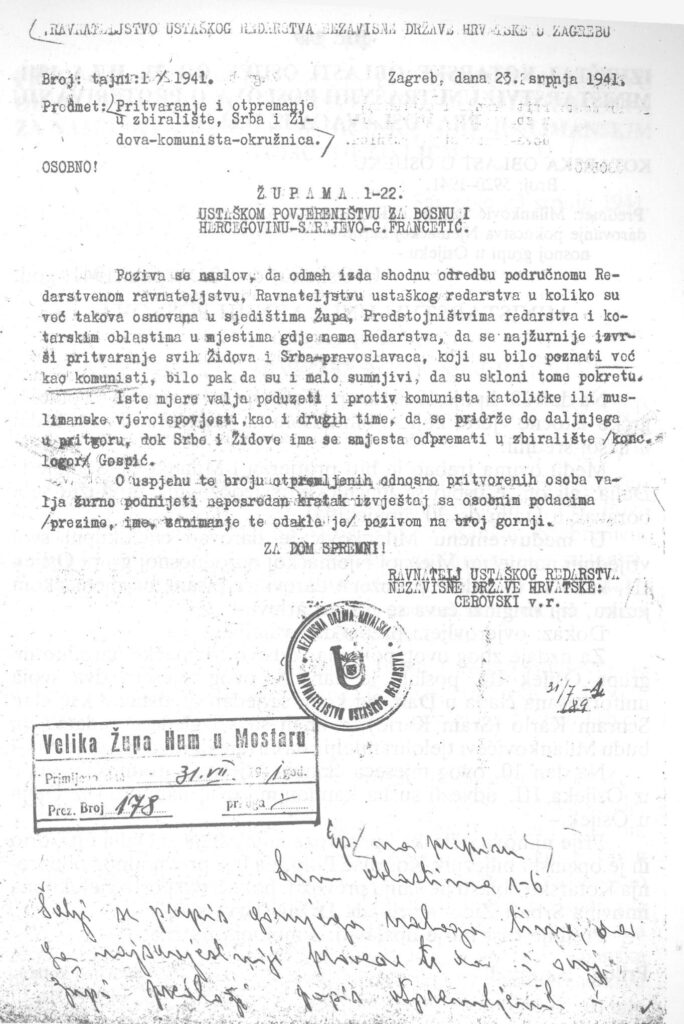
DIRECTORATE OF USTAŠA SURVEILLANCE SERVICE
INDEPENDENT STATE OF CROATIA IN ZAGREB
Number: secret: 1/1941.
Subject: Detention and dispatch to 1
collection point, Serbs and
Jews-communists circular.
PERSONAL!
Zagreb, 23rd July 1941.
COUNTIES 1-22.
USTAŠA COMMISSION FOR BOSNIA AND
HERZEGOVINA – SARAJEVO – MR. FRANCETIĆ.
The recipient is called upon to immediately issue a corresponding order to the local Directorate of Security, the Directorate of Ustaša Surveillance Service where such have already been established in the headquarters of the Counties, the Head Offices of Surveillance Service and district areas in places where there is no Surveillance Service, to most urgently carry out the arrest of all Jews and Orthodox Serbs, who are either already known as communists or are even slightly suspicious of being inclined towards that movement.
The same measures should also be taken against communists of Catholic and Muslim faith, as well as others, to hold them in custody until further notice, while Serbs and Jews are to be immediately sent to the collection centre /concentration camp/ in Gospić.
A direct brief report with personal details /surname, first name, occupation, and origin/ referring to the above number should be urgently submitted regarding the success and number of people dispatched or detained.
ZA DOM SPREMNI!
M.P.
DIRECTOR OF THE USTAŠA SURVEILLANCE SERVICE
OF THE INDEPENDENT STATE OF CROATIA:
Cerovski v.r. [Božidar]
Copy stored at the Military Historical Institute, Military Archives, ANDH, book 189, reg. number 31/7-1
INDEPENDENT STATE OF CROATIA
Sarajevo Surveillance Service Directorate
Office for Immigration and Emigration
Number: 40
TO THE STATE DIRECTORATE FOR REBUILDING
Z A G R E B
It is an honour for this Office to inform the above address that 209 Slovenians from the concentration camp in Požega have been deported to the area of the city and district of Sarajevo.
In the Sarajevo district area, 43 Slovenians or 17 families have been settled, about which the district head of the district authority in Sarajevo will inform you.
In the area of the city of Sarajevo, 51 families have been settled as follows, by name:
| 1/ | Ambrož Josip | 3 members | 19/ | Cipot Franjo | 2 members |
| 2/ | Arko Štefanija | 2 members | 20/ | Cotić Justina | 5 members |
| 3/ | Bavdaž Josip | 2 members | 21/ | Čibelj Andrija | 3 members |
| 4/ | Brecelj Franc | 4 members | 22/ | Čejhan Franjo | / members |
| 5/ | Bedenik Anton | 4 members | 23/ | Dobrila Franjo | 4 members |
| 6/ | Bitežnik Jozef | 2 members | 24/ | Dervarić Stjepan | 5 members |
| 7/ | Bizjaž Emil | 4 members | 25/ | Deleot Amalija | 6 members |
| 8/ | Blošić Atilija | 2 members | 26/ | Domjan Kaiman | 6 members |
| 9/ | Belak Franjo | 2 members | 27/ | Drnošek Fridrih | 3 members |
| 10/ | Berg Ferdinand | 3 members | 28/ | Eferl Danica | 1 member |
| 11/ | Božić Petar | 6 members | 29/ | Branko Petar | 2 members |
| 12/ | Bozi Rudolf | 2 members | 30/ | Felić Franko | 1 member |
| 13/ | Božić Emil | 5 members | 31/ | Gabavšek Franjo | 4 members |
| 14/ | Bune Izidor | 3 members | 32/ | Gornjo Dušan | 4 members |
| 15/ | Bradnjak Henrik | 4 members | 33/ | Grahov Toma | 1 member |
| 16/ | Bratus Srečko | 4 members | 34/ | Gselman Karl | 1 member |
| 17/ | Bremžak Alojzije | 5 members | 35/ | Gospod Vicanc | 2 members |
| 18/ | Bersa Albin | 2 members | 36/ | Grus Gotfrid | 4 members |
| 37/ | Gabrijelčić Jernjej | 5 members | 45/ | Obersnel Adolf | 1 member |
| 38/ | Gregorić Alojz | 4 members | 46/ | Resinović Franc | 3 members |
| 39/ | Germek Franjo | 4 members | 47/ | Sluga Leopold | 2 members |
| 40/ | Hore Ljudevit | 2 members | 48/ | Stefančić Franjo | 4 members |
| 41/ | Krstić Stefa | 1 member | 49/ | Urekar Martin | 7 members |
| 42/ | Krošerec Marija | 2 members | 50/ | Volk Marija | 1 member |
| 43/ | Kočevar Rudolf | 4 members | 51/ | Žerjal Franjo | 2 members |
| 44/ | Lešnik Jozef | 1 member |
The aforementioned families have been accommodated in Jewish and Serb households for housing, as we do not yet have available apartments from the removed Serbs and Jews since only 9 Serb families have been relocated through this Office.
Regarding nutrition, we encounter the following difficulties. Jews to whom we assign the resettled Slovenes usually have officers established in their shops, and from these officers, they receive only enough resources that they themselves struggle to make ends meet. Thus, it is impossible for them to provide for the assigned family’s sustenance.
However, we must note that a certain number of Jewish families have voluntarily come forward, willing to take on the supply of smaller Slovenian families.
When placing Slovenians in housing with Jewish and Serb families, one difficulty arose in that most of these families do not have enough bedding and covers.
We organised the arrival of the transport in the following manner:
At the station, the transport was received by representatives of the Red Cross, the local District Head, and the director of this Office. In the station restaurant, the Red Cross served tea and bread to the adults and milk to the young children.
From the station, they were transported by trucks to temporary collection centres located in the dormitories1 “Narodna Uzdanica” and “Gajret”,2 as well as in the Apprentice Home.
The following morning, we instructed Kajić the baker to bake 209 loaves of bread from the flour we had in storage, which had been seized from 9 Serb families who had been removed through this Office. Additionally, 50 litres of milk were purchased. This was distributed to them for that day. On their part, the Red Cross distributed 50 litres of milk and 10 kilograms of bacon for that day.
On the same day during the afternoon, 46 individuals were transported by lorries to various estates in the vicinity of Sarajevo. Concurrently, other Slovenian families were being placed in private flats, and the work regarding this redistribution is still ongoing.
Sarajevo, 25 July 1941.
Director of Surveillance Service:
/Signature illegible/
Original stored at the Military Historical Institute, Military Archives, ANDH, book 179, reg. number 21/1-1
Roy. Ita. Vice Consulate
BANJA LUKA
Express Telegram No. 65.
Roy. Ita. Consulate – Zagreb
Roy. Gen. Consulate – Sarajevo
Location: A.P.l.
Banja Luka, 26 July 1941/XIX-
Subject: Measures for the expulsion of Serbs.
Reference: My express telegram No. 18 from the 9th of this month and telegrams No. 22 and 23 from the 12th and 13th of this month.
As I have reported in the telegrams marked above, on the 13th of this month, about 150 Orthodox families residing here were transported by rail to Slavonska Požega, where they are now located.
With the departure of the aforementioned families, who were among the wealthiest in Banja Luka, the number of Orthodox Christians remaining here has decreased by 2000. However, they had previously left voluntarily. It is said that by the month of October, all Orthodox Christians and Jews will have to be relocated elsewhere, but this is considered unfeasible given the difficulties the authorities have encountered so far in relocating the first contingents of these people. Here, almost all Orthodox Christians are staying in the fields, where they are a majority compared to Muslims and Catholics. It is estimated that their number in the area of the former Vrbas Banovina is around 40,0003 compared to 180,000 Muslims and 135,000 Catholics. As for the real estate and generally all the property left behind in this city by the refugees or exiles, it has been confiscated by the local authorities who have sealed the doors of the apartments. I learned that some houses, with furnishings, have been requisitioned by the local German command, which has used them for officers’ and soldiers’ quarters. Mainly, the flats left vacant by Serbs and Jews, which have been taken over by Croatian authorities, will first be used, where needed, for German occupation troops and then for local Croatian authorities. There have been more than a few instances of differences in the handling of Serb-owned real estate between the German command and the headquarters of Dr. Gutić.
Regarding the shops, which belonged to Orthodox Christians or Jews and are located in this town, they have largely been entrusted to the leadership of a Croatian trustee, who has been appointed for this purpose.
The expulsion of Orthodox Christians from the area of the former Vrbas Banovina is based mostly on personal criteria, at the discretion of the headquarters staff and the relevant Grand Župan. Indeed, while not a single Orthodox Christian remains in Bihać, in Banja Luka, as I mentioned earlier, about 2000 remained. Some had time to pack their bags and take care of their property appropriately, while others had to leave within a few hours. Many entrusted part of their easily transferable property to parents or friends of the Catholic faith, who could stay here undisturbed, but a recent measure by the local police authorities requires all those entrusted with property from Orthodox Christians to declare it under the threat of severest penalty.
One significant measure is the provision issued by the local headquarters commander on the 21st of this month, directed at all regional authorities of the former Vrbas Banovina, which mandates the collection by all possible means of all registers held by Orthodox parishes, and their delivery to the nearest Catholic parish offices.
Furthermore, many Slovenes from the Slovenian area, which was annexed by Germany in accordance with the treaty reached between the Reich government and Croatia, have begun arriving in this city. On the 20th of this month, about 200 arrived, who have temporarily settled in the building of the Mercantile Academy.
Roy. Vice Consul:
Fabiani v.r.
Original stored at the Military Historical Institute, Military Archives, ANDH, book 153-a, reg. number 13/5-124
Banja Luka, 29th July 1941.
INDEPENDENT STATE OF CROATIA
Ustaša Surveillance Service
Number 304 1941
TO THE SURVEILLANCE DIRECTORATE
BANJA LUKA
Enclosed is a list of the Jews detailed below with a request that they be prepared at your Directorate, as they will be transported to a concentration camp.
Once all have been delivered, please notify this Directorate.
| 1./ | Poljokan R. Jakob | 7./ | Levi L. Mamo released4 |
| 2./ | Kraus D. Aleksandar | 8./ | Baum I. Lavoslav |
| 3./ | Montijas H. Rafael | 9./ | Polgar R. Franjo |
| 4./ | Montijas H. Isak | 10./ | Levi M. Leon |
| 5./ | Poljokan R. Isak | 11./ | Levi M. Josef |
| 6./ | Montijas I. Jozef | 12./ | Levi M. Albert |
| 13./ | Levi J. Isak | 28./ | Altarac I. Jozef |
| 14./ | Rot M. Josip | 29./ | Laslo M. Ignjat |
| 15./ | Najbah B. Hugo | 30./ | Salom. A. Avram |
| 16./ | Zeliković A. Samuel | 31./ | Levi T. Isak |
| 17./ | Štajnhauf L. David | 32./ | Baruh J. Isak |
| 18./ | Nahmijas D. Jozef | 33./ | Braun M. Julio released (Mr. Rebac) |
| 19./ | Štajnlauf H. Izidor | 34./ | Levi S. Morie |
| 20./ | Nahmijas S. Jozef | 35./ | Altarac M. Miko |
| 21./ | Levi J. Majer | 36./ | Lihtenštajn I. Jozef |
| 22./ | Montijas H. Leon | 37./ | Papo S. Jozef |
| 23./ | Levi I. Hajim | 38./ | Papo A. Sumbul released |
| 24./ | Nahmijas J. Samuel | 39./ | Salom Albert Bertin |
| 25./ | Hofman M. Filip released (Mr Rebac) | 40./ | Kabiljo A. Elijas |
| 26./ | Bramer R. Ernest Mr Rebac | ||
| 27./ | Hercog M. Leopold |
ZA DOM SPREMNI!
DIRECTOR OF THE USTAŠA SURVEILLANCE SERVICE
BANJA LUKA
SUPERVISOR OF THE USTAŠA
SURVEILLANCE SERVICE FOR
THE FORMER VRBAS BANOVINA
Ozren Kvaternik
Original stored at the Military Historical Institute, Military Archives, ANDH, book 169, reg. number 2/2
INDEPENDENT STATE OF CROATIA
SURVEILLANCE SERVICE DIRECTORATE
SARAJEVO
Office for Immigration and Emigration.
Number: 49/4
Sarajevo, 29th July 1941.
TO THE STATE DIRECTORATE FOR RECONSTRUCTION
ZAGREB
It is an honour for this Office to submit to you a report on the arrival and distribution of the transport we received from the concentration camp in Požega on the 26th of July this year.
The total number of Slovenians arrived amounts to 208. In taking over these Slovenians from the local district authorities and on our part, we have adhered and will continue to adhere to the principle of dividing the settlers into two groups right at the station. One group will be transported further to the area of the districts, and the other group will be allocated to the city of Sarajevo.
In the area of the city of Sarajevo, 85 families have been settled as follows:
| 1) Uršula Žagar | 11) Alojz Zagar |
| 2) Ivan Žagar | 12) Uršula Koren |
| 3) Ivan Rolih | 13) Marija Premzel |
| 4) Alojsija Goijav | 14) Štefan Novak |
| 5) Anton Hiti | 15) Daniela Hribar |
| 6) Karl Poiane | 16) Ida Nalešek |
| 7) Rudolf Lunder | 17) Franc Jare |
| 8) Josip Stuler | 18) Adolf Svijetličić |
| 9) Alojz Kaucian | 19) August Smerdu |
| 10) Franc Pangerc | 20) Mateuš Ogrič |
| 21) Ignac Gosar | 54) Alojz Ranfl |
| 22) Franjo Sedmal | 55) Karl Ramšak |
| 23) Josefa Počkar | 56) Franc Peseh |
| 24) Metod Golajner | 57) Leopold Šrimf (Schrimpf) |
| 25) Eduard Pitamić | 58) Jozefa Cigala |
| 26) Terezija Zorn | 59) Franc Vidrih |
| 27) Jakob Rešek | 60) Josip Vidi |
| 28) Franc Košuta | 61) Franc Vrhljak |
| 29) Miloš Krajger | 62) Terezije Miler (Miller) |
| 30) Vinko Virens | 63) Lorenc Makuc |
| 31) Iva Gvardijančić | 64) Blaž Ravnjak |
| 32) Vladislav Ruter | 65) Franc Stvarnik |
| 33) Andrija Vodičar | 66) Jernej Sedej |
| 34) August Gajšek | 67) Igor Mervić |
| 35) Alojz Paječić | 68) Franjo Sabatin |
| 36) Jozef Seme | 69) Franjo Pirit |
| 37) Franc Ljubešek | 70) Josip Erzetić |
| 38) Franc Župane | 71) Aleksandar Mrevlje |
| 39) Martin Cvenk | 72) Jožef Repenšek |
| 40) Jakob Ciglav | 73) Ana Sare |
| 41) Antun Hribar | 74) Katarina Durjava |
| 42) Štefan Majcen | 75) Franc Hribljan |
| 43) Rudolf Pajnik | 76) Matej Pire |
| 44) Peter Farčko | 77) Karl Pavelka |
| 45) Roza Lah | 78) Leopold Potočnik |
| 46) Milenko Kos | 79) Ambroz Podbrešić |
| 47) Ferdo Menher | 80) Josip Ukmar |
| 48) Mauricij Novak | 81) Anton Bratković |
| 49) Franc Močnik | 82) Alojz Kocijančić |
| 50) Alojz Geratić | 83) Franc Seučnikar |
| 51) Zlata Kos | 84) Olimpija Likavec |
| 52) Rajmund Ivanuša | 85) Jožef Skulj |
| 53) Anton Hriber |
During the acceptance of these families and their distribution across temporary shelters, Mr. Ojiković, the Director of Surveillance Service in Sarajevo, was also present this time.
Based on the experience we gained during the arrival of the first transport and with the necessary effort, we managed to, despite the delay in notification of the transport’s arrival, load the resettled into lorries and transport them to the shelters, as well as deliver their luggage to the shelters, all within an effective time of just 2 hours.
Likewise, the organisation of food provision has been much more satisfactory than the organisation during the arrival of the first transport.
From the faces of these people, as well as during conversations with them, there is an evident satisfaction, despite the fact that, despite our best intentions, not everything is going as we would wish on our part.
The placement of families in private homes continues to be based on the principle we adhered to with the first transport, i.e., placement is carried out in the private homes of wealthy Jews and Serbs.
The difficulties we mentioned in our last report of 25 July this year, under no. 40, and in the report of 29 July this year, no. 44, continue to recur, but we hope that this will be largely resolved the moment all state and self-governing offices receive circulars from you regarding the handling of the issue concerning the settled Slovenians.
It is particularly important to us in the matter of their definitive employment.
In feeding, we adhere to the principle that the food should be simple, healthy, and plentiful. For example, in one day in the morning, each person receives 65 grams of fresh bread, children get milk, and adults tea or black coffee. For lunch, they are served boiled beans with bacon in very generous portions and very tastily prepared, as the lunch is cooked by Slovenian cooks who were found in the transport and who voluntarily and very gladly do the job. For dinner, they receive dry food such as bacon, sausages, or similar.
As a special remark, we must mention the following case:
With this transport, Slovenian Katarina Durjan also arrived, who is usually registered in Ljubljana, where her husband is still stationed working on the railways. This woman happened to be visiting Maribor when the German authorities organised this transport, and thus she accidentally found herself in the predicament of being brought here, although she normally lives in Ljubljana. She has with her a citizenship certificate and a confirmation from the Italian authorities that her husband is stationed in Ljubljana. We inform you that we will do everything on our part to send this woman to her husband in Ljubljana.
Further, we have nothing special to report except that through the cooperation of some local Directors of offices, we are managing to employ some immigrants, and the work around this is very current these days. We ask You again to send the already mentioned circulars so that everything would proceed much faster to both your and our satisfaction.
Likewise, the work regarding placement in private homes is ongoing.
If you desire any special information, please inform us so that we can provide you with a clearer picture of the local circumstances.
ZA DOM SPREMNI!
DIRECTOR OF THE SURVEILLANCE SERVICE
/signature illegible/
Original stored at the Military Historical Institute, Military Archives, ANDH, book 179, reg. number 23/1
DIRECTORATE FOR PUBLIC
ORDER AND SECURITY FOR
THE INDEPENDENT STATE OF
CROATIA.
Reference: 15013/11-1941.
Subject: Serbs and Jews under suspicion due to communism – procedure.
In Zagreb, on the 30th of July, 1941.
TO ALL GRAND ŽUPAS –
SURVEILLANCE SERVICE DIRECTORATES: ZAGREB,
BANJA LUKA, SARAJEVO. –
In the interest of public safety, all Jews /baptised or not/, and Serbs /converted to Catholicism or not/, suspected of communism and against whom there is otherwise no evidence to bring before a court martial, are to be sent to the collection camp of the Župa Surveillance Service Directorate in Gospić.5
Regarding this order, inform and direct all subordinate authorities.
Za Dom Spremni!
M.P.
By order of the Director:
HEAD OF DEPARTMENT:
Vutuc, v.r.
Original stored at the Military Historical Institute, Military Archives, ANDH, book 169, reg. number 8/2
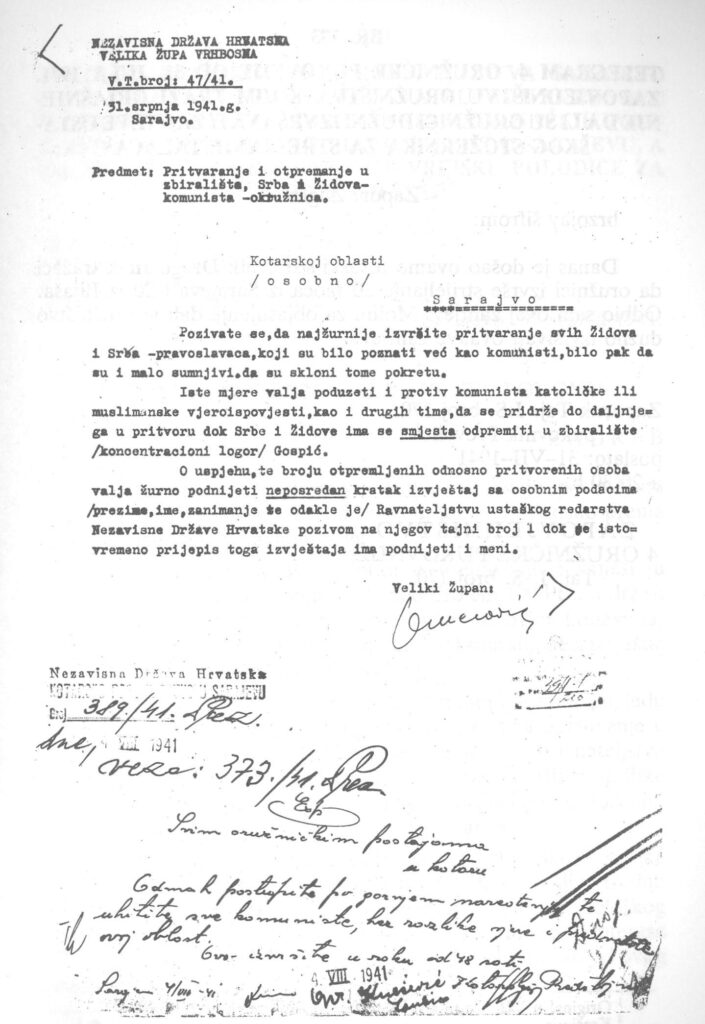
INDEPENDENT STATE OF CROATIA
GRAND ŽUPA OF VRHBOSNA
Str. Conf. No.: 47/41
31st July 1941
Sarajevo
Subject: Detention and dispatch to collection centres of Serbs and Jews – communists – circular.
DISTRICT AREA
/ personal /
Sarajevo
You are hereby requested to urgently carry out the arrest of all Jews and Serbs – Orthodox Christians, who are either already known as communists or are even slightly suspicious of being inclined towards that movement.
The same measures should also be taken against communists of Catholic or Muslim faith, as well as others, to be held in custody until further notice, while Serbs and Jews are to be immediately sent to the collection point /concentration camp/ in Gospić.
Regarding the success and the number of people dispatched or detained, an immediate brief report with personal details (surname, first name, occupation, and origin) must be urgently submitted to the Directorate of the Ustaša Surveillance Servcice of the Independent State of Croatia, referring to its secret number 1, while a copy of this report must also be submitted to me.
Grand Župan:
Omerović [Derviš]
“To all police stations in the district: Immediately act according to the above order and arrest all communists, regardless of religion, and bring them to this area. Execute this within 48 hours.” – written by the the district chief by hand on the document.
Original stored at the Military Historical Institute, Military Archives, ANDH, book 200, reg. number 39/1-1
INDEPENDENT STATE OF CROATIA
SURVEILLANCE SERVICE DIRECTORATE
SARAJEVO
Office for Immigration and Emigration.
Number: 60
Sarajevo, 31 July 1941.
TO THE STATE DIRECTORATE FOR REBUILDING
ZAGREB
This Office, since its establishment, has carried out its assigned task primarily in accordance with legal provisions or according to the instructions of the esteemed Directorate.
Referring to your “Guidance on the Settlement and Accommodation of Slovenians” dated 9th July 1941, under number 190/Ptk, and bearing in mind the particular circumstances prevailing in these regions, we are free to submit the following report based on our observations and to make the following proposal accordingly.
Slovenian immigrants have been referred in full, both in terms of immediate sustenance and in terms of prospects for future maintenance, to this Office. As the esteemed Directorate is aware, they arrive in these regions with almost no means, due to material circumstances, and, in terms of psychological disposition, are dissatisfied with the new movement that is emerging.
The placement of these Slovenian immigrants in Jewish and Serbian families has its justification from the standpoint of fairness, but it would also be appropriate to consider whether this is advisable from a psychological standpoint, as there is a risk of creating a coordination of interests through underground means that cannot be successfully controlled, neither by this Office nor by the most authoritative factors.
To both Jews and Serbs, and particularly to the resettled Slovenians (after all, why else would they be displaced), at this moment the common enemy is the new order in Europe, as well as everything that serves and works towards it. In our opinion, they will find many, very many points of contact on this matter.
There is a fear that they might create a front which is unnecessary and with which we might have to contend in the future, and all this, in our opinion, is unnecessary and superfluous, and this danger can easily be avoided.
At the same time, in these regions, there lives a relatively large number of affluent Slovenes, who are either state officials, craftsmen, traders, or industrialists. All of them lead a very orderly bourgeois life, at the very least lacking nothing, and some indeed live quite lavishly.
In addition to the personal tragedy experienced by these our Bosnian Slovenians and despite their previous organisation in various Slovenian societies, so far only one instance has been found where our Scots have shown interest in the fate of their compatriots and voluntarily offered their assistance, whether material or moral, to these immigrant compatriots and to this Office.
This occurrence has had an unpleasant effect on the responsible officials of this Office, especially since they believe that when the Independent State of Croatia provides opportunities for prosperity to individuals to such an extent that they can be unimpeded owners of estates worth millions, and receive regular monthly incomes from the Independent State of Croatia amounting to tens of thousands of kunas, it would be humane, compassionate, patriotic, and socially responsible for these well-provided Slovenes to at least make their services available to their compatriots and to the Independent State of Croatia, which offers them hospitality, as well as to this Office, which strives to find the means and opportunities to fulfil its honourable and patriotic duty.
Based on all the foregoing, we propose:
1) That Slovenian settlers be housed in Jewish and Serbian families only in cases of extreme necessity.
2) That Slovenian settler families be primarily accommodated in Slovenian families already present here, regardless of whether the heads of these families are officials, merchants, craftsmen, or industrialists.
For this purpose, it would be necessary to conduct a census of all Slovenians in the city of Sarajevo, and according to our proposal, a person would be considered Slovenian on this occasion:
a) any state, self-governing, or municipal official who, from the year 1918 until before this war, declared in their official record that they are Slovenian.
b) Any current citizen of the Independent State of Croatia who was born, and whose father was also born, in those Slovenian areas that are today outside the Independent State of Croatia.
c) Anyone who, from the year 1918 until before this war, was for a certain period a member of any Slovenian society.
d) Anyone who is known to have represented Slovenian official policy against the interests of the Croat people.
3) That a census of all Slovenians in the city of Sarajevo be conducted to establish the name of the head of each Slovenian family, the number of family members, property, and monthly income of that household, and that a certain percentage of about 10% to 15% of these incomes be allocated to this Office for the needs concerning the care of immigrants. A specific percentage would be set for all immovable properties that yield a certain rent, and this percentage, in our opinion, would be about 25%.
4) That a strict order be issued to all municipalities within their jurisdiction to collect the aforementioned contributions (point 3) and to accurately deliver them to this Office every month.
5) Under no circumstances can any Slovenian found in these regions be exempted from this duty.
These would primarily be the guidelines of our proposal to resolve the issue of the resettled Slovenians simply and fairly, and to provide the local Slovenians with an ideal opportunity and possibility to fulfil their primary patriotic duty.
It is understood that this Office will continue to act in all matters according to previous orders and instructions until the resolution of this issue, but we also urgently request the resolution of this proposal.
ZA DOM SPREMNI!
GRAND ŽUPA VRHBOSNA
SARAJEVO
The above is forwarded herewith for your information.
DIRECTOR OF SURVEILLANCE SERVICE
/signature illegible/
- Tran. note: These were dormitories meant for out-of-town and poorer pupils at the local schools. ↩︎
- Tran. note: “Narodna Uzdanica” and “Gajret” were Muslim societies dedicated to the education of Muslim youths and general cultural work. ↩︎
- Tran. note: most likely a typo in the telegram, with a 0 missing as there were 600,259 Orthodox Christians in the Vrbas Banovina recorded in the 1931 census. ↩︎
- Tran. note: The original of the document has a hand-written note “released” next to the names numbered 7, 25, 33 and 38. Name under 26 is crossed out. All the notes and corrections were done and signed by Mr Rebac, the secretary of the Ustaša Surveillance Service in Banja Luka. ↩︎
- Tran. note: An Italian report from 28.07.1941. from Zadar to the Italian governor of Dalmatia stated that according to their sources, the village of Smiljan near Gospić had a camp with 5000 Orthodox Serbs held there and they were held in conditions which were so poor that they are slowly killing all who are there. ↩︎