Dragana Amedoski
Gordana Garić Petrović
The remains of the old settlement are located in the very centre of contemporary Kruševac, on one of the lower terraces oriented toward the valley of the West Morava River (Zapadna Morava).1 Although the first written sources on the above-mentioned settlement come from a late period and are quite scarce, six cultural layers (Neolithic, Bronze Age, Iron Age, Early Medieval Period, Medieval Period, and Turkish Period), superseding one after the other, testify there was a continuous settlement of this geographically dominant location on the confluence of the Garski Brook with the West Morava River. The layer richest with architectural remains belongs to period of Prince Lazar.2
Because Kruševac was the centre of the Serbian State during the last quarter of the 14th century, and the centre of defence from the approaching Ottoman threat, the majority of researchers directed their attention to the Medieval Period of this town’s history. There are very few papers dedicated to the development and life of Kruševac during the Ottoman period. We would like to bring attention to the work of Olga Zirojević, Kruševac in the 16th and 17th Centuries, as well as to the collections of papers Kruševac through Centuries and Artistic Topography of Kruševac.3
The aim of this text is to present the process of transformation of one of the most important urban centres of Serbia into the capital of the same-named Sandjak. While working on this paper, we were using Serbian Medieval charters, biographical and literary texts.4 The reconstruction of the image of Kruševac upon the establishment of the Ottoman rule was based on several Ottoman censuses undertaken in the 16th century and on the vaqf registers included in the censuses.5 Results of archaeological researches conducted during the second half of the last century supplement written sources to a great extent.6
Urban Topography
The town was mentioned for the first time in January 1387, in the written sources that we know of until now. That was when Prince Lazar issued a charter to the Ragusans, confirming their earlier privileges.7 Constantine the Philosopher tells us of the town’s construction in The Biography of Despot Stefan [Житије Деспота Стефана]. In his words, the Prince erected the town and a beautiful church in it, dedicated to Saint Stephen.8
Church of the Holy Protomartyr Stephen, Better Known as the Lazarica Church Today it is known as Lazarica. The construction of the Kruševac fort and the church within it was set in the period of an intensive construction activity, when numerous monuments were either built or renovated. The Epoch of the Morava style, in which the most important edifices of Medieval Kruševac were executed, gave birth to the most original Serbian achievements in the Medieval architecture and art.
Adoption of the triconchal ground plan for sacral buildings, polychromous effects and specific bas-relief ornaments in stone make up the key components of this style. The Lazarica Church was also built in that vein, one of the groups of court churches erected within towns.9
Relics of Holly Petka were most likely, in that church at some point. Princess Milica (known as nun Yevgeniya), the sons of Prince Lazar—Stefan and Vuk, and nun Yefimiya entreated Sultan Beyâzit I for the relics of St. Petka and had them translated from Vidin to Serbia “to the holy church in their home.”10 The church was damaged for the first time in 1413, during Prince Mûsâ’s campaign.11 After the fall of the Serbian Medieval State, the church was not demolished. In his itinerary, written in 1669, Edward Brown mentioned it as a beautiful church with two nice towers. In his military description of the Serbian territories under Ottoman rule, written in 1784, Joseph Paul Mitesser spoke about a very large, built, but partly dilapidated church, which used to be the crown church of Prince Lazar. At that time, the church served as a horse barn. During the Austro-Turkish War of 1790, Colonel Mihaljević ordered the church to be cleaned and made proper it for the Orthodox Vesper Service. During the first half of the 19th century, it was used as hay barn and ammunition magazine until Kruševac was adjoined to the Principality of Serbia in 1833.12
The Fort
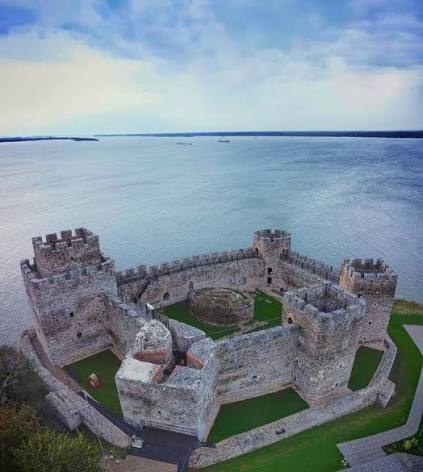
At the same time as the church, the walls around the Great Town (Veliki Grad) were erected. Their remains lie on the plateau elevated a few meters above the large plains stretching along the West Morava River. The Kruševac Fort had an elongated shape stretching in the direction Southwest–Northeast. The shape of the ground plan was adjusted to the terrain, since the walls of the Town encompassed natural plateau. The lengths of the fort are 300 m, in the direction North–South; and 200 m in the direction East–West.13
Within the fortification, the better preserved complex of the Citadel (i.e. Small Town) stands out. The remains of the main tower with one smaller tower, a ramp and a trench are preserved in it. The Great Town was separated from the Small Town by the above-mentioned trench. Remains of at least five smaller towers and one small gate were established on the unearthed part of the large town rampart. Remains of thirty-five buildings were established within this fortification complex, besides the Church of Saint Stephen on which restoration efforts were conducted in several turns. A separate unit within the Great Town was the Court with auxiliary facilities, a horse stable, a forge and a water reservoir. Water was flowing to the tank through the opening on the Southern wall, and from the underground stream beneath one of the towers. The Small Town and the Court with its auxiliary facilities were built at the same time, most likely, and possibly by the same mason craftsmen. While the ramparts of the Great Town were built of a different stone material and with lower foundations.14
Because of its strategic significance, Kruševac was often the target of the attacks during the wars between the Serbs and the Turks. It was attacked in 1413, during the campaign of Mûsâ Çelebi, son of the Sultan Beyâzit I, and during the war 1425–7, when Sultan Murâd II took control of it.15 By that time, some areas of the fort were dilapidated, which is why Bertrandon de la Broquière who was passing through Kruševac in 1433 noted:
and that town is very small and well-fortified with a double wall, which crumbled at the top where the battlement is, and there was one tiny town, which is destroyed now.16
New depredations befell the town during the Hungarian campaigns of 1437 and 1443. According to the testimony of the Hungarian court historian Antonio Bonfini (1427–503), whose records were echoed by Mavro Orbin (1601), Kruševac was completely in ruins, which is why the Sultan had it renewed in 1449, having in mind its strategic importance. After the damages sustained in the hostilities of 1454/1455, Kruševac passed under the Ottoman rule lastingly.17 In that period, most likely, some of the fortification structures lost their earlier role, as is the case with the defensive trench in front of the Small Town, which was filled in with earth, turning it into a land plot for construction of a residential building and of a street paved with cobblestone that connected the rest of the town with the area around the main tower, where a smaller craftsmen settlement sprung up.18
At the beginning of the 16th century, the fort lost the importance it had until then, which is why it was not even listed as a fortified settlement in 1516. Evliya Çelebi reported 150 years later that the fort in Kruševac was of a hexagonal shape, and was built in alternating layers of white and black stones. He saw there a few poor households, a certain amount of ammunition, two cannons and the westward gate. This picture stayed more or less the same even after 120 years. Meanwhile, the palisade ramparts were erected around the town with seven wooden houses in its circle, most of them one storey high with spacious stables and yards.19
Oriental Constructions
Kruševac, the centre of the Serbian Medieval State, kept its relevance as a regional centre until the final fall under the Ottomans in 1455. Because of the strategic importance of its location, Kruševac kept being a settlement with a pronounced military function. As such, it was chosen for the seat of the Ottoman administration in this area.20
Soon after the Ottoman conquest, Kruševac gained the status of kasaba, which it kept throughout the entire 16th century. The transformation of this Serbian Medieval town into an Oriental-urban centre was executed under the wing of religious foundations. Vaqfs as Islamic religious endowments were established in order to satisfy the religious and educational needs of ever increasing Muslim population. The first founders of vaqf buildings in the newly conquered areas were sultans and borderland begs. Besides the prominent state servants, rich townspeople were also active in such benefactory efforts.21 Thus came to be many buildings such as mosques, mescids, mektebs and medreses, as well as hâns, kervânserâys, bridges, drinking fountains, hammâms, ‘imârets and tower clocks, which were for the public benefit of all inhabitants, regardless of their religious or national affiliation.22
The construction of the first important buildings of Islamic architecture in Kruševac should be dated to the time of the first Ottoman administration in the town. In the sources from the 16th and the 17th centuries, Sultan Murâd is named the founder of the Emperor’s Mosque and of a hammâm. Although it was not specified which Sultan Murâd was about, it can be claimed with certainty that this was the first conqueror of Kruševac, Sultan Murâd II (1421–44, 1446–51). No particular town mahalle sprung around this oldest mosque in Kruševac, in contrast to the usual development of Balkan towns. The reason lies most likely in its position, considering it was located in the old part of the town, subsequently named the Old Bâzâr.23 This part of town which was developing already in the Middle Ages stretched North and West of the town walls of the Great Town. And as Evliya Çelebi wrote in 1661, a Turkish town later sprung up there. According to his writings, the town lay in one expansive field on the Western and the Northern sides of the fort in such a way that it was surrounded on both sides by gardens on cultivated, lower hills.24 Remains of a mosque and of a hammâm were substantiated archeologically on that site. Their mutual proximity and position indicate that these are the already-mentioned oldest vaqf buildings from the mid-15th century. Other, less likely possibility is that the above-mentioned temple remains belong to the Mosque of Hüdâvendigâr for which Evliya Çelebi wrote was located in the Bâzâr. Ami Boué wrote in the mid-19th century about the ruins of a fountain and of an old Mosque with a wooden roof and without minaret, located in a street full of shops.25 The Mosque was demolished at the beginning of the 20th century. During the archaeological excavations, it was established that the foundations and floors of the building have been completely preserved.26 Beside them, remains of an old fountain were discovered.27 The Mosque and the hammâm were damaged for the first time, or maybe even completely destroyed, after the Hungarian incursions. It was renewed in 1455 by Murâd‘s successor, Mehmed the Conqueror, after the final Ottoman capture of Kruševac. Sultan Murâd‘s Mosque was the centre of the town’s spiritual, cultural and educational life. Income assigned to the Mosque’s vaqf was coming from a part of cizye collected in Kruševac and in one of the villages in the Petruš nâhiye. In addition to these assets, the vaqf of the Mosque also disposed with large sums of money bequeathed by the wealthy townspeople of Kruševac.28
About hundred meters North of the Mosque lie remains of a hammâm, a singular building of this kind in Kruševac, whose importance was such that one of the town’s mahalle was named after it.29 In 1840 Ami Boué made mention of its ruins.30 During the archaeological excavations, it was determined that the walls of the building were made of bricks and stones, while the floors of the interior were entirely made of stone. In addition, remains of the system for cold and hot water supply, a swimming pool and the remains of the heating system were also discovered within the hammâm. Decorated vessels of stone that were used as washbasins were found in three rooms.31 Erecting the hammâm and the Mosque with a water fountain in the central yard called for renovation of the existing or, more likely, construction of new waterworks, one of the most important utilities in town. Maintaining one of the waterworks, which connected all of the mentioned buildings, was the task of one Christian service man on the vaqf‘s payroll.32
First civilian administrative buildings were built immediately after the conquest. A certain Şa‘bân-beg made the town courthouse and the auxiliary buildings around it part of the vaqf, establishing the so-called Courthouse Mahalla.33 Another two important structures were erected in the early period of the Ottoman rule, built by borderland commanders; ‘Alî-beg Mihaloglu, a famous borderland beg and an akıncı commander founded the zâviye, while Fîrûz-Ağa, after whom one of the town mahalle was named, established the mescid.34
One of the most important vaqf was established in the first decades of the 16th century, its founder being a certain Hâcî Mehmed. In the mahalle named after him, he first founded a mescid, to which he bequeathed the income of 840 akçes, coming from ten stores with a kervân-serây, then 8,000 akçes in cash, and arable land near the mescid, meant to provide for imâm, teacher, supervisor, müəzzin and mütevellî. Until 1536, Hâcî Mehmed enlarged his vaqf by building a school—mekteb next to the existing mescid.35
Still, until Belgrade fell in 1521, construction of civil facilities and foundations were relatively rare in Kruševac as it was a military stronghold primarily. Only after the transfer of military campaigns into the Southern parts of the Hungarian Kingdom, did establishing foundations and endowments enter full development mode. In this period, beside the mescid and mekteb of Hâcî Mehmed, three more mescids were constructed by: Mustafâ, son of Kulak, by kethüdâ Mahmûd, and by Emîr Mahmûd. Mehmed, son of Murâd, erected by 1584 another mekteb in Kruševac. In this period, another two mosques were constructed, Hâcî Ibrâhîm’s and Mahmûd-beg’s, forming new mahalles.36 The construction of the above-mentioned buildings facilitated, to a large extent, the formation of the town’s new urban structure, the same that Evliya Çelebi saw in the mid-17th century. He remarked that there were nine Muslim temples, one medrese, two zâviyes, three schools; three big and one small merchant hân as well as 150 shops made out of wood.37
Population and Economy
Throughout the 16th century, Kruševac was a small town with a strong Muslim majority. Although the total number of denizens in the town stayed equal, the Muslim community was constantly increasing. At the same time, the number of Christians was falling, especially between the censuses of 1516 and 1530, when their percentage in the entire population of the town decreased from 40.9 % to 22.6 %.38
In the few coming years, the dispersal of population continued, but it was not as drastic. In the census of 1536, urban Muslim population was registered in these 13 mahalles: Seyyidi Hoca, muytâb Mehmed, Turmuş, Hâcî Mehmed, knez Mustafâ, Sofu Oruç Akıncı, hammâm, Iskender naʻlbant, Ayas, meyhâne, Pobrežje, Courthouse, and Ca’fer topçu. On that occasion, 215 names of heads of families were noted. At that time, the Christian community was significantly smaller and consisted of 40 families. They lived in the following mahalles: Kraguj, Old Kruševac, Dobrolin, and in the old fort.39
The demographic situation stabilized by 1570, and the population increased, with the number of adult men, both Christian and Muslim, increasing to 346 in just under four decades.40 The intense process of Islamization was also taken note of, during the same period, so of the total number of Muslims registered in 1570, 31.3 % were converts. Similar situation was noted in the census of 1584.41 According to that census, Kruševac was a predominantly Muslim town, with 284 Muslim and 41 Christian households. Out of the total number of Muslims, there were 55 new ones, with a euphemistic name ‘Abdullâh.42
In the period between 1536 and 1584, the number of mahalles stayed the same, and some of them were registered under the earlier name (hammâm mahalle, court-house mahalle, mahalle Sofu Oruç, mahalle Ayas, mahalle Kraguj, mahalle Dobrolin, Old mahalle, and mahalle Pobrežje or Pobrđe). Of the 18 registered mahalles, 14 were Muslim, one was Roma and two were Christian, while one mahalle was diverse.43
Table 1. The Population of Kruševac in the 16th Century
| 1516 | 1530 | 1536 | 1570 | 1584 | |
|---|---|---|---|---|---|
| Muslims | 204 | 226 | 215 | 288 | 284 |
| Christians | 141 | 66 | 45 | 58 | 41 |
| Total | 345 | 292 | 260 | 346 | 325 |
A significant part of the population of Kruševac belonged to the merchant- and craftsmen-class. In 1536, the following occupations are mentioned in the çârsı: leather tanners, shoemakers, salters, dyers, blacksmiths, haircloth weavers, wool-carders, healers, whitesmiths, and tailors.44 Fifty years later, the following trades were listed: tailors, barbers, bakers, haberdashers, cobblers, leatherworkers, tanners, earth-house builders, felt-makers, halva makers, butchers, locksmiths, and whitesmiths. The tailor and baker trades were especially well-developed. All registered craftsmen belonged to the Muslim majority, no Christians among them.45
| 1536 | 1584 | |
|---|---|---|
| Barbers | – | 2 |
| Boyacis | 2 | – |
| Çarıkçıs | – | 3 |
| Çilingers | – | 2 |
| Dungers | – | 1 |
| Gazzazes | – | 2 |
| Habbâzes | – | 5 |
| Hallâçs | 1 | – |
| Hayyât | 1 | 14 |
| Helvacis | – | 2 |
| Kalaycis | 2 | 1 |
| Kassâbs | – | 3 |
| Keçecis | – | 1 |
| Kovaçes | 1 | – |
| Muytâbs | 2 | – |
| Naʻlbants | 4 | – |
| Pâbuççus | 1 | – |
| Serrâçes | – | 3 |
| Tabbâks | 2 | – |
| Total | 17 | 40 |
The last traces of this vibrant craftsmen activity of the Ottoman period disappeared at the end of the 18th and beginning of the 19th century. Ami Boué noted that prior to the annexation to the Principality of Serbia, Kruševac dwindled to just two streets that led to the fort. One of them was, according to his words, gloomy and filthy, full of shops and a few huts at the end of it, with Gypsy blacksmiths living in the huts.
Unlike the monumental public and sacral buildings, most of the economic buildings in the Kruševac çârsı were made of wood or wattle, leaving no traces to be found on the site, the exception being pottery and blacksmith workshops. Thanks to the technology of metal casting and metal forging, and of baking pottery, it was possible to detect the remains of the buildings where these economic activities were performed. The remains of a pottery workshop were discovered within the Great Town, North of the Lazarica Church, in the area between the Church and the town walls. The complex consists of the workshop itself, built or wattle and daub mixed with chaff, a stone slab in front of the workshop and two pottery kilns with pits in front of the hearth. Based on the pottery material, these two pottery ovens could be dated to the period ranging from the 16th to the 18th centuries.46 In their vicinity, there are remains of a forgery, a small dug-in structure with walls coated with mud, with entrance through a staircase.47 A certain amount of mallets, nippers and hammers was found inside. The quantity of metal objects necessary for performing regular household activities (knives, awls, scissors), as well as of the craftsmanship tools (for wood, metal and bone working) indicate a well-developed production of the local town craftsmen.48
Besides the craftsmanship, one of the principal economic activities in Kruševac was the developed commerce. Exchange of goods was performed on the town square. Agricultural goods (grains, fruits, vegetables, vine, wood, eggs, honey, fat, lard, fish, lambs, sheep, and cattle), iron and wooden products (iron bars, hoes, ploughs, cauldrons, chairs, and wooden shovels), and textile products (linen cloth, broadcloth, baize cloth, rain coats, shirts, trousers, and horse equipment) were traded. Imported goods, such as olive oil and salt, were also sold there. The high merchant taxes also testify of the importance the Kruševac square market had. By 1570, the tax, together with penalties and taxes on vine barrels, and marriage taxes amounted to 38,646 akçes.49 One part of the import-export trade was in the hands of Ragusan merchants who exported salted and raw oxen and cattle hides from the Kruševac area, prepared and dyed lambskin, wool and wax. In the last decade of the 16th century, one of the most active merchants from Dubrovnik was Nikola Stjepanović who sold in his two shops fabrics, clothes, arms, jewellery, iron goods and salt.50 The import of luxury murano glass objects, as well as of the glassware from Czech workshops, speaks about the considerable purchasing power and the wealth of the Kruševac çârsı.51
Conclusion
Kruševac was one of the most important urban centres of Medieval Serbia during the second half of the 14th century and the first half of the 15th century. At the time, it was the seat of the Serbian Prince Lazar Hrebeljanović, who built the fort, the court, and the church dedicated to Saint Stephen. The remains of the old settlement are located in the very centre of contemporary Kruševac. Constantine the Philosopher tells us of the town’s construction. In his words, the Prince erected the town and a beautiful church in it, dedicated to Saint Stephen (Lazarica). The construction of the Kruševac fort and the church within it was set in the period of an intensive construction activity belonging to the Epoch of the Morava Style. After the fall of the Serbian Medieval State, the church was not demolished but served as a horse and hay barn and ammunition magazine. In the same time, the fort lost the importance it had until then, which is why Kruševac was not even listed as a fortified settlement. Preceding the 17th century wars, the palisade ramparts were erected around the town.
Soon after the Ottoman conquest (1455), Kruševac gained the status of kasaba, which it kept throughout the entire 16th century. The transformation of this Serbian Medieval town into an Oriental-urban centre was executed under the wing of religious foundations. By the year 1476, Kruševac got two zâviyes and a mescid. During the first half of the 16th century, Hâcî Mehmed founded one of the most important vaqfs in Kruševac. It comprised mescid, mekteb and kervân-serây. Around 1536, three new mescids and zâviyes were constructed and by 1570 at latest, one mekteb and one mosque.
Throughout the 16th century, Kruševac was a small town with a strong Muslim majority. Although the total number of denizens in the town stayed equal, the Muslim community was constantly increasing. A significant part of it belonged to the merchant and craftsmen-class. The high merchant taxes testify of the importance the Kruševac square market had. The import of luxury murano glass objects, as well as of the glassware from Czech workshops, speaks about the considerable purchasing power and the wealth of the Kruševac çârsı.
Author’s note: the paper results from project no. 177,030 funded by the Ministry of Education, Science and Technological Development of the Republic of Serbia.
- Kruševac is a city in present-day Central Serbia. It is an administrative and economic center of Rasina District—xxx Opštine i regioni u Republici Srbiji (Beograd, 2012), 19. ↩︎
- A. Jurišić, Č. Jordović, “Lazarev grad, Kruševac—Srednjevekovni grad,” Arheološki pregled 4 (1962), 248–53. ↩︎
- Olga Zirojević, “Kruševac u XVI i XVII veku,” Zbornik Istoriskog muzeja Srbije 11–2 (1975), 51–8; M. Vasić, “Stanovništvo kruševačkog sandžaka i njegova društvena struktura u XVI vijeku,” in Kruševac kroz vekove. Zbornik referata za simpozijuma održanog od 4. do 9. oktobra 1971. u Kruševcu (Kruševac: Narodni Muzej, 1972), 49–72; Radmila Tričković, “Kruševački sandžakbegovi u XVIII veku,” in Ibid., 81–91; T. Popović, “Dubrovačka kolonija u Kruševcu u XVI veku,” in Ibid., 73–9; R. Veselinović, “Kruševac i Kruševljani u austro-turskim ratovima u XVII i XVIII veku,” 111–32; P. Trajković, “Kroz istoriju Kruševca,” in Umetnička topografija Kruševca (Novi Sad–Kruševac: Matka srpska–Bagdala, 1990), 37–146. This topic was pursued by Dragana Amedoski, one of the authors of this text, in the following papers: “Kruševac u osmanskom popisu iz 1536. godine,” Mešovita građa 29 (2008), 45–54; “Orijentalne građevine Kruševca od osmanskog osvajanja do kraja XVI veka,” Istorijski časopis 55 (2007), 157–69. Kratak pregled istorije Kruševca pod osmanskom vlašću daje: Aleksandar V. Fotić, “Alaca Hisar (Kruševac),” in The Encyclopedia of Islam. Three 2010–1 (Leiden, Boston: Brill, 2010), 59–60. ↩︎
- Aleksandar Mladenović, Povelje kneza Lazara. Tekst, komentari, snimci (Beograd: Čigoja štampa, 2003), 193, 194, 197, 200; Vatroslav Jagić, “Konstantin Filosof i njegov Život Stefana Lazarevića, despota srpskog,” Glasnik SUD XLII (1875), 223–328; Grigorij Camblak, Slovo o prenosu moštiju svete Petke iz Trnova u Srbiju (“Prenos svetitelskih moštiju kao tema srpske srednjovekovne knjizevnosti”). Prevod i napomene Đorđe Trifunovića (Požarevac: Časopis “Braničevo,” 1972). ↩︎
- The original material this paper is based on is kept in the Archive of the Prime Ministry in Istanbul and is a part of the archival series Tapu Tahrir Defterleri. Two summary censuses of the Sandjak of Kruševac from 1516 (TD 55) and 1530 (TD 167) belong to it, as do the three comprehensive censuses of the same Sandjak: from 1536 (TD 179), from c. 1570 (TD 567)—the Era of Sultan Selim II (1566–74), and from 1584 (TD 95). Of these censuses only the 1530 summary census of the Sandjak of Kruševac was published fully—67 numaralı muhâsebe-i vilâyet-Rûm-ili defteri (937/1530), II, Vılçıtrın, Prizrin, Alaca-hisâr ve Hersek Livâları (Dizin ve Tıpkıbasım) (Ankara: Başbakanlık Devlet Arşivleri Genel Müdürlüğü. Osmanlı Arşivi Daire Başkanlığı Yayın Nu: 69, Defter-i Hâkânî Dizisi: IX, 2004.) ↩︎
- A. Jurišić, Č. Jordović, op. cit.; M. Kovačević, “Srednjovekovna tvrđava Kruševac,” Starinar XVIII (1966), 137–41; A. Jurišić, Č. Jordović, “Rezultati arheoloških ispitivačkih radova u Kruševcu,” Saopštenja 9 (1970), 289–306; Dušica Minić, “Grnčarska radionica iz srednjovekovnog Kruševca,” Starinar 28–9 (1977–8), 153–65; M. Kovačević, “Profana arhitektura srednjovekovnog Kruševca. Rezultati dosadašnjih istraživanja,” Arheološka istraživanja Kruševca i moravske Srbije (Beograd: Arheološki Institut, 1980), 13–29; Id., “Ostaci srednjovekovnog grada Kruševca,” in Umetnička topografija Kruševca…, 147–54; B. Vulović, “Lazarica, crkva sv. Stefana u Kruševcu,” in Ibid., 155–66; Dušica Minić, “Primenjena umetnost u srednjovekovnom Kruševcu,” in Ibid., 167–80. ↩︎
- S. Novaković, Zakonski Spomenici Srpskih Država Srednjega Veka. Prikupio i Uredio… (Beograd: Peta Knjiga, 1912), 202 [in Chyrillic]. ↩︎
- “… syzda gradyj tvrydyj, syzda ùe i Krouwevycy glagolëmyji, vy ëmyùe syzda krasynhiwouü crykovy velikomou pryvomouqenikou, arxidäkonou Stefanou vy molybou o prisynopomynimhmy syjnh svoëm”—V. Jagić, op. cit., 262. ↩︎
- B. Vulović, op. cit., 155–6, 161. ↩︎
- Saint Parascheva of the Balkans is a saint who lived her ascetic life in Thrace at the end of tenth century and at the beginning of the 11th century. The Bulgarian Emperor Jovan Asen translated her relics from Epivata to Trnovo in the 13th century. From Trnovo, the relics were translated to Vidin in 1393 and to Serbia in 1398. After the fall of Belgrade in 1521, the refugees from Belgrade translated them to Constantinople. Moldavian Voivode Vasile Lupu bought them off and translated to Iaşi, where the relics still are—Grigorij Camblak, op. cit., 465, 467. ↩︎
- B. Vulović, op. cit., 163. ↩︎
- Edward Brown (1642–707) was the personal Physician of King Charles II of England. At the end of 1699, he commenced his long journey to Turkey. On that occasion, he was passing through Serbia twice. His notes were published in 1673. Joseph Paul Mittesser was an Austrian officer and subsequently, a Consul in Travnik. On a mission by the Austrian authorities, he travelled through central Serbia in 1784 and compiled a detailed report on his itinerary—Đ. Kostić, Lj. Ristić, O gradu, gospodstva mi, Kruševcu (Kruševac-Beograd: Bagdala-LutErazmo, 1997), 32, 39, 44–5, 56, 68, 74, 81, 89, 113–4, 116. ↩︎
- M. Kovačević, “Profana arhitektura…,” 14–5; Id., “Ostaci srednjovekovnog…,” 149–53. ↩︎
- Id., “Profana arhitektura…;” Id., “Ostaci srednjovekovnog…,” 26; Id., “Srednjovekovna tvrđava Kruševac…,” 138–9; A. Jurišić, Č. Jordović, “Rezultati arheoloških…,” 299, 302–4. ↩︎
- M. Spremić, “Kruševac u XIV i XV veku,” in Kruševac kroz vekove…, 23. ↩︎
- Bertrandon de la Brokijer, Putopis putovanje preko mora: kroz Palestinu, Malu Aziju, Srbiju i Francusku (Beograd: Čigoja štampa, Biblioteka Reprint izdanja 7, 2002), 127. ↩︎
- After the death of Murâd II (1421–51), his successor Mehmed II (1451–81) gave back to Despot Đurđe (1427–56), together with Princess Mara, the areas of Toplica and Dubočica. Besides these lands, during the period 1451–3, the areas around Kruševac, Koznik, Petruš and Bovan were under the Serbian rule. These lands fell under the Ottoman rule in September or October 1453, as most timars were given from the Despot’s tahvîl at that time. These territorial changes were confirmed by the new peace treaty signed in 1455 between the Serbs and the Turks—Momčilo Spremić, Despot Đurađ Branković i njegovo doba (Beograd: Srpska književna zadruga, 1994), 362, 460; R. Ćuk, “Carica, Mara,” Istorijski časopis 25–6 (1978–9), 66; D. Amedoski, V. Petrović, “Tvrđava Koznik—od prvog pomena do kraja 16. veka,” Vojno-istorijski glasnik 2 (2011), 127–37; Olga Zirojević, Ismail Eren, “Popis oblasti Kruševca, Toplice i Dubočice u vrijeme prve vladavine Mehmeda II (1444–1446),” Vranjski glasnik 4 (1968), 378; Siniša Mišić, “Obnova Despotovine i njene granice (1444–1459),” in xxx Pad Srpske despotovine 1459. godine (Beograd: SANU. Naučni skupovi, Knjiga CXXXIV, Odeljenje istorijskih nauka, knjiga 32, 2011), 66; Dragana Amedoski, “Orijentalne građevine…,” 158. ↩︎
- A. Jurišić, Č. Jordović, “Rezultati arheoloških…,” 299. ↩︎
- Đ. Kostić, Lj. Ristić, op. cit., 39. ↩︎
- Aleksandar V. Fotić, op. cit. ↩︎
- Endowment encouraged by the faith (sadaka) did not pertain only to the building of the facilities but to its maintenance, as well. To that purpose, loans were often bequeathed, at a certain interest (ribh). Part of the income for vaqf came from renting the vaqf’s facilities, or from the income generated from the land, mills or shops in vaqf property. These funds were used for the maintenance of the endowments, for the clerk salaries, for financing humanitarian activities, such as public kitchens and hospitals, or it could be used to support the inheritors of the endowers. On the Islamic endowment in the Western Balkan Peninsula, see—Mehmed Begović, Vakufi u Jugoslaviji (Beograd: Naučno delo. Series Srpska Akademija Nauka i Umetnosti. Posebna izdanja, Knj. 361. Odeljenje društvenih nauka; Knj. 44, 1963), 102 pp.; Adem Handžić, “O formiranju nekih gradskih naselja u Bosni u XVI stoljeću (Uloga države i vakufa),” Prilozi za orijentalnu filologiju [Sarajevo] XXV (1975), 133–69; Hasan Kaleši, “Prizrenac Kukli-beg i njegove zadužbine,” Ibid. VIII–IX (1958–9) [1960], 143–68; Id., “Najstarija vakufnama u Jugoslaviji,” Ibid. X–XI (1960–1) [1961], 55–73; Id., “Jedna arapska vakufnama iz Ohrida iz 1491.godine,” Ibid. XII–XIII/1962–3 (1965), 15–44; H. Kaleši, I. Eren, “Prizrenac Mahmud-paša Rotul, njegove zadužbine i vakufname,” Starine Kosova VI–VII (1972–3), 23–64; B. Zlatar, “Popis vakufa u Bosni iz prve polovice XVI stoljeća,” Prilozi za orijentalnu filologiju XX–XXI (1970–71); Olga Zirojević, “Vakuf-ugaoni kamen gradova,” Novopazarski zbornik 17 (1993), 67–71; Aleksandar Fotić, “Uloga vakufa u razvoju orijentalnog grada: beogradski vakuf Mehmed-paše Jahjapašića,” in Socijalna struktura srpskih gradskih naselja (XII–XVIII vek) (Smederevo–Beograd: Muzej u Smederevu. Odeljenje za istoriju Filozofskog fakulteta u Beogradu, 1992), 149–59; T. Katić, “Muslimanske zadužbine u Pirotu od XIV do XVI veka,” Pirotski zbornik 32/33 (2007/8), 55–62; Dragana Amedoski, “Leskovački vakufi u periodu od osmanskog osvajanja do kraja XVI veka,” Istorijski časopis 57 (2008), 137–49; Id., “Women Vaqfs in the Sixteenth-Century Sandjak of Kruševac (Alaca Hisâr),” Balcanica 40 (2009), 43–55. Numerous papers are dedicated to this topis, issued in the magazines Glasnik islamske vjerske zajednice and Anali Gazi–Husrevbegove biblioteke. ↩︎
- Id., “Orijentalne građevine Kruševca…,” 160. ↩︎
- Ibid., 164. ↩︎
- Đ. Kostić, Lj. Ristić, op. cit., 30. ↩︎
- Ami Boué (1794–881) was a French geologist and explorer who travelled throughout the South-Eastern Europe and wrote his itinerary, a valuable historical source—Đ. Kostić, Lj. Ristić, op. cit., 74. ↩︎
- M. Kovačević, “Ostaci srednjovekovnog…,” 152. ↩︎
- Id., “Srednjovekovna tvrđava Kruševac…,” 140. ↩︎
- D. Amedoski, “Orijentalne građevine Kruševca…,” 162. ↩︎
- Ibid., 164. ↩︎
- Đ. Kostić, Lj. Ristić, op. cit., 58, 114. ↩︎
- M. Kovačević, “Ostaci srednjovekovnog…,” 152. ↩︎
- D. Amedoski, “Orijentalne građevine Kruševca…,” 164. ↩︎
- Within the yard of the courthouse were a stable, two houses, one barn and one meadow. The income of the vaqf amounted to 2,500 akçes (aspers) in cash, having in addition the incomes from the mill and the meadow. The founder decreed that food should be offered to the travellers who spent the night here, and forage to their horses—Ibid., 165. ↩︎
- Mills, buildings and meadows were meant to support ‘Alî-beg Mihaloglu’s zâviye. But their income was not sufficient to provide for the travellers and over time, the zâviye became dilapidated. Because of this, around 1530 the Porte transferred this zâviye into Sultan Murâd’s vaqf and the income from another two villages from the vicinity of Kruševac was assigned to it, thus providing additional means for the travellers. The income of Fîrûz-ağa’s mescid came from one rice winnowing facility, from a four-grindstone mill, six shops in Kruševac, and one meadow. The annual income of this vaqf amounted to 3,680 akçes, used to finance the salaries of its employees and the daily expenses. The imâm and the müezzin of the mescid were obliged to recite one juz’ from Qur’an every day, for the benefit of the founder. By 1536, this vaqf were given as a gift a house for imam and the sum of 10,000 akçes. This income structure was preserved in the subsequent decades—Ibid., 165–6. ↩︎
- Ibid., 166–7. ↩︎
- TD 95, 39; Dragana Amedoski, op. cit., 167–8. ↩︎
- Đ. Kostić, Lj. Ristić, op. cit., 30. ↩︎
- Dragana Amedoski, op. cit., 168. ↩︎
- Id., Kruševac u osmanskom popisu…, 45–54. ↩︎
- TD 567, 33–6. ↩︎
- Defterhâne-i Âmire Tahrîr Defteri (hereinafter referred to as TD) 95. Tapu ve Kadastro Genel Müdürlügü (TK), Kuyud-ı Kadime Arsivi (KKA), Ankara. ↩︎
- TD 567, s. 29b–30a, 33a–70b; TD 95, 38–41. In 1516 there were 314 Muslims, in 1530–280, in 1536–297, 27 converters, and in 1570, approximately 338 Muslims, 106 converters—TD 55, 4–11, 15–6, 20–36, 167 numaralı muhâsebe-i vilâyet-Rûm-ili defteri (937/1530), II, 403–9, TD 179, 46, 68–74, 103-63, TD 567, 29b–30a, 33a–70b. ↩︎
- TD 95, 38–41. ↩︎
- Dragana Amedoski, op. cit. ↩︎
- TD 95, 38–41. ↩︎
- Dušica Minić, “Grnčarska radionica…,” 153. According to Aleksandra Fostikov, the workshop was most likely established during the Medieval Period—Aleksandra Fostikov, “Zanatstvo u Kruševcu i okolini u 14. i 15. veku. Prilog proučavanju zanatstva u srednjovekovnoj Srbiji,” Moravska Srbija. Istoriia. Kultura. Umetnost (Kruševac, 2007), 241–2. ↩︎
- M. Kovačević, “Ostaci srednjovekovnog…,” 152. ↩︎
- Dušica Minić, “Primenjena umetnost…,” 171. ↩︎
- Olga Zirojević, Kruševac u XVI i XVII veku…, 55. ↩︎
- T. Popović, “Dubrovačka kolonija u Kruševcu…,” 77–8. ↩︎
- Dušica Minić, op. cit., 170–1. ↩︎