COUNTRY Yugoslavia
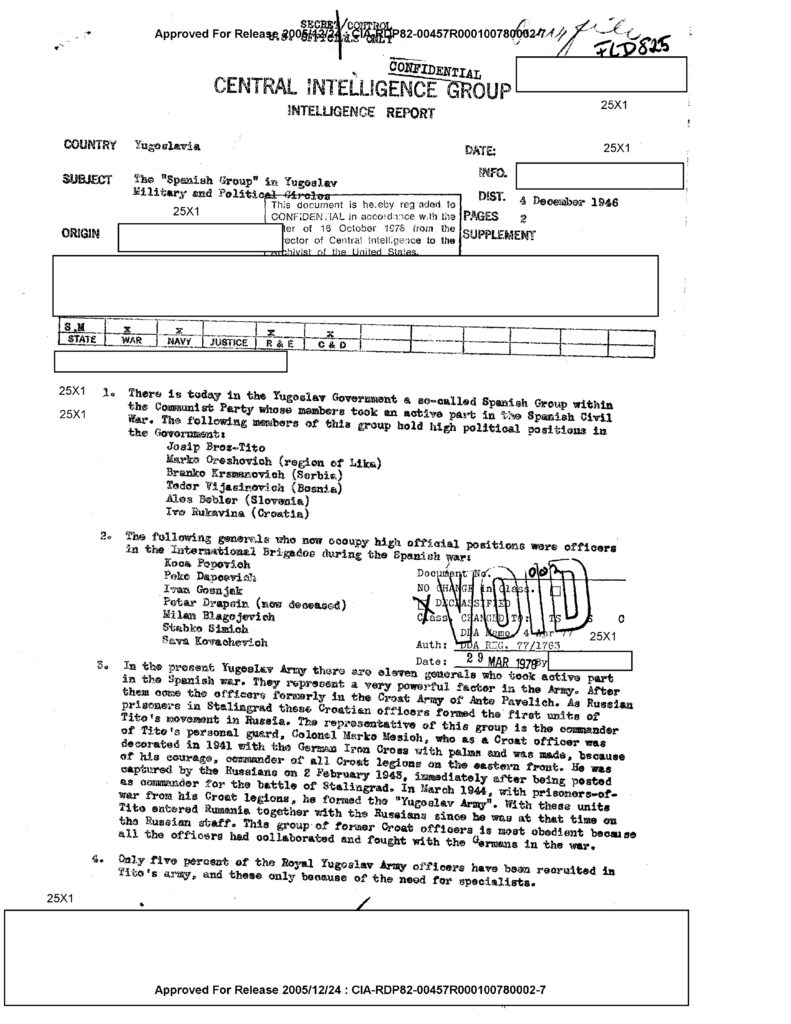
SUBJECT The “Spanish Group” in Yugoslav Military and Police Circles
- There is today in the Yugoslav Government a so-called Spanish Group within the Communist Party whose members took an active part in the Spanish Civil War. The following members of this group hold high political positions in the Government:
Josip Broz-Tito
Marko Oreshovich (region of Lika)
Branko Krsmanovich (Serbia)
Todor Vijasinovich (Bosnia)
Alos Bebler (Slovenia)
Ivo Rukavina (Croatia)1 - The following generals who now occupy high official positions wore officers in the International Brigades during the Spanish War:
Koca Popovich
Peko Dapcevich
Ivan Gosnjak
Petar Drapsin (now deceased)
Milan Blagojevich
Stabko Simich
Sava Kovachevich2 - In the present Yugoslav Army there are eleven generals who took active part in the Spanish way. They represent a very powerful factor in the Army. After them come the officers formerly in the Croat Army of Ante Pavelich.3 As Russian prisoners in Stalingrad these Croatian officers formed the first units of Tito’s movement in Russia. The representative of this group is the commander of Tito’s personal guard, Colonel Merko Mesich,4 who as a Croat officer was decorated in 1941 with the German Iron Cross with palms and was made, because of his courage, commander of all Croat legions on the eastern front. He was captured by the Russians on 2 February 1943, immediately after being posted as commander for the battle of Stalingrad. In March 1944, with prisoners of war from his Croat legions, he formed the “Yugoslav Army”. With these units Tito entered Rumania together with the Russians since he was at the time on the Russian staff.5 This group of former Croat officers is most obedient because se all the officers had collaborated and fought with the Germans in the war.
- Only five percent of the Royal Yugoslav Army officers have been recruited in Tito’s army, and these only because of the need for specialists.
- The commander of the Yugoslav Air Fores is General Frnja Pirc,6 a former Colonel in Pavelich’s army and commander of the pilot training school in Petrovaradin. Former officers of the Pavelich “Croat Air Force” make up tho basis of the present Yugoslav Air Force. The political commissars are former workers from the Ikarus and Rogarski airplane factories. This is explained by the fact that the Spanish Group hag no representatives in the Air Force, and all Royal Yugoslav Air Force personnel have emigrated.

- BoJ note: Marko Orešković, Branko Krsmanović, Todor Vujasinović, Aleš Bebler, Ivan (Ivo) Rukavina. Of these, Branko Krsmanović had died in 1941, Todor Vujasinović was not a participant of the Spanish Civil War. ↩︎
- BoJ note: Konstantin (Koča) Popović, Peko Dapčević, Ivan Gošnjak, Petar Drapšin, Milan Blagojević, Slavko Simić, Sava Kovačević. Of these, Milan Blagojević had been killed in 1941, Slavko Simić may have been a nom de guerre and Sava Kovačević was not a participant of the Spanish Civil War and was killed in 1943. ↩︎
- BoJ note: Ante Pavelić, the Poglavnik of the Independent State of Croatia and the Ustaša orgnisation. ↩︎
- BoJ note: Marko Mesić. ↩︎
- BoJ note: Reorganised as the “First Yugoslav Volunteer Brigade”. The events in Romania came after Tito’s departure from Yugoslavia following the Battle of Drvar, first going to Naples, then the Anglo-American based on the island of Vis, then to Moscow. ↩︎
- BoJ note: France/Franjo Pirc. ↩︎